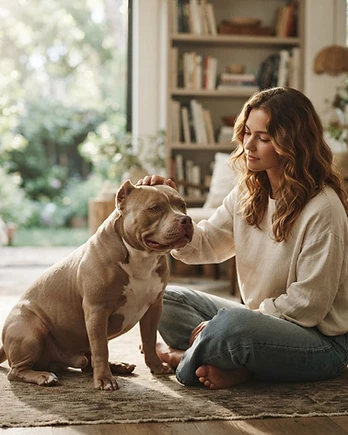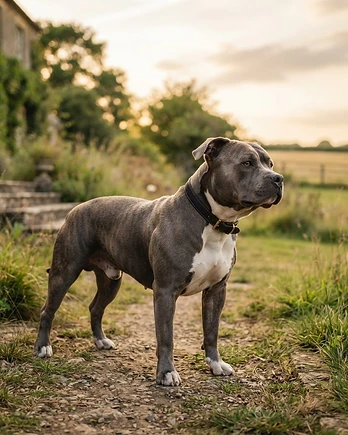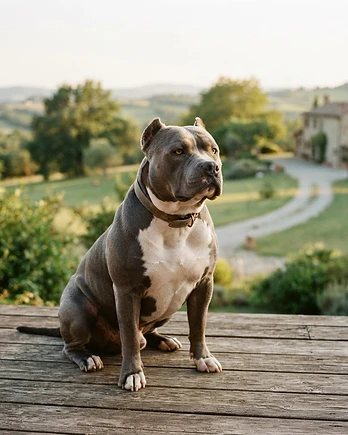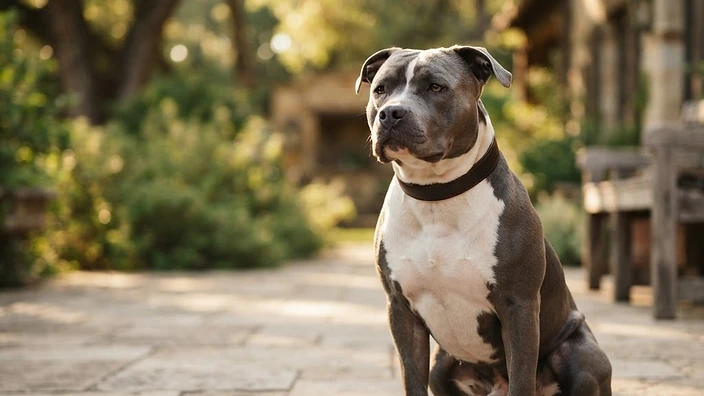
Few breeds in the modern era have captured hearts — and stirred curiosity — quite like the American Bully. With a physique that commands attention and a temperament that melts it away, this breed occupies a unique space: visually imposing yet profoundly gentle, athletically built yet deeply devoted to family life. Whether you're a first-time prospective owner researching every detail before making a commitment, or an experienced enthusiast looking to deepen your knowledge, you've arrived at the right place.
At American Bully Haven Pups, we've dedicated ourselves to breeding structurally sound, health-tested, emotionally balanced American Bullies in Austin, Texas — registered with both the ABKC and UKC. We've walked through whelping boxes at 3 a.m., studied pedigrees across generations, and placed puppies in homes across the country. That first-hand experience shapes every word of this guide.
This is the most comprehensive American Bully resource we've ever assembled. It covers the breed's origin and development, all four ABKC-recognized size varieties, the official conformation standard, every recognized coat color and the genetics behind them, the foundational bloodlines that shaped the breed, how the American Bully compares to related breeds, and everything you need to know before bringing one home. Bookmark it, share it, and return to it often — because the more you know about this breed, the more you'll love it.
Origin and History of the American Bully
The American Bully is a young breed by canine standards, developed primarily during the 1980s and 1990s in the United States — with roots in both the East Coast and West Coast breeding communities. The breed's primary foundation is the American Pit Bull Terrier (APBT), itself a descendant of early 19th-century British bull-and-terrier crosses brought to America. Breeders selectively crossed the APBT with the American Staffordshire Terrier (AmStaff) and, to varying degrees, the Staffordshire Bull Terrier, English Bulldog, and in some lines, the American Bulldog — with the explicit goal of amplifying the blocky, muscular, wide-chested aesthetic while simultaneously softening working-dog drive into a more family-oriented, biddable companion temperament.
The result was a dog that looked bolder and more substantial than its APBT forebear but carried a noticeably calmer, more tolerant disposition — particularly with children and strangers. Early influential breeders on the East Coast (notably in Virginia and the mid-Atlantic region) and simultaneously on the West Coast helped establish the aesthetic and temperament benchmarks that define the breed today.
In 2004, the American Bully Kennel Club (ABKC) was founded to create a formal breed registry, establish a written conformation standard, and provide a sanctioned show platform. This was a pivotal moment — it gave the breed official recognition, defined its varieties, and distinguished it clearly from the American Pit Bull Terrier. The United Kennel Club (UKC) followed with formal recognition in 2013, cementing the American Bully's status as a distinct, legitimate breed rather than a variation of the APBT.
Today, the American Bully is one of the fastest-growing breeds globally, with active registries, competitive show circuits, and dedicated breeder communities across North America, Europe, Asia, and beyond.
The Four ABKC-Recognized Size Varieties
One of the most distinctive — and sometimes confusing — aspects of the American Bully is that it exists in four officially recognized size varieties under the ABKC standard. These are not separate breeds; they share the same conformation standard, temperament expectations, and structural requirements. Size is the primary differentiator, measured at the withers (top of the shoulder blades).
Pocket Bully
The Pocket Bully is the smallest recognized variety. Males measure under 17 inches at the withers (but no less than 14 inches); females measure under 16 inches (but no less than 13 inches). Despite the compact frame, Pocket Bullies carry the same wide chest, heavy bone, and muscular mass as larger varieties — resulting in a remarkably dense, powerful package. They are highly popular as urban companions due to their manageable size, and they often carry some of the most exaggerated head and body structure in the breed.
Standard Bully
The Standard American Bully is considered the blueprint variety. Males measure 17–20 inches at the withers; females measure 16–19 inches. The Standard represents the breed's intended balance of musculature, bone density, and proportional structure. Most ABKC conformation competition is built around the Standard, and it's the reference point from which all other varieties are judged.
Classic Bully
The Classic shares the same height parameters as the Standard but carries a lighter body frame with less overall muscle mass and less exaggerated features. The Classic most closely resembles the American Pit Bull Terrier in overall silhouette while still meeting American Bully structural requirements. It's an important variety for breeders who prioritize athletic conditioning and working-dog functionality alongside the Bully aesthetic.
XL Bully
The XL American Bully is the largest recognized variety. Males measure over 20 inches up to 23 inches at the withers; females measure over 19 inches up to 22 inches. XL Bullies carry imposing size and substance while still conforming to the breed's structural standard — straight topline, broad skull, well-sprung ribs, and correct angulation. Weight in XL males can range from 80 to 150+ pounds depending on structure and conditioning. Despite their size, well-bred XL Bullies maintain the same gentle, family-oriented temperament as their smaller counterparts.
Note: The ABKC also acknowledges an Extreme class within the Standard variety — characterized by heavier bone, more pronounced muscle, and more exaggerated head features — though this is a show class designation rather than a separate size variety.
| Variety | Male Height | Female Height | Relative Frame | |---------|-------------|---------------|----------------| | Pocket | 14–under 17 in | 13–under 16 in | Compact, dense | | Standard | 17–20 in | 16–19 in | Balanced, reference | | Classic | 17–20 in | 16–19 in | Lighter, athletic | | XL | 20–23 in | 19–22 in | Large, imposing |

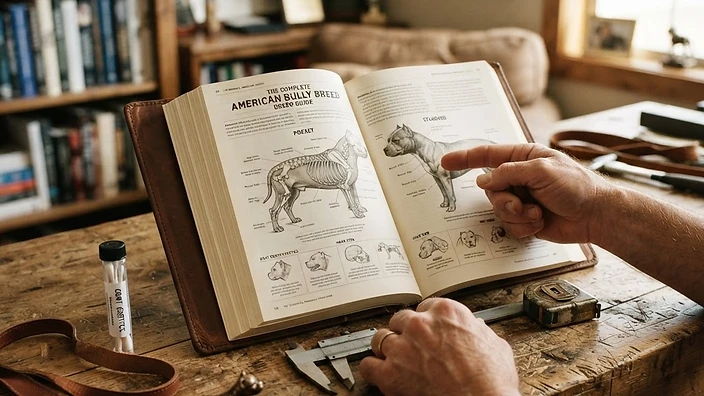
ABKC Conformation Standard: What Makes a Correct Bully
The ABKC conformation standard is the authoritative written description of the ideal American Bully. Understanding it matters not only for show prospects but for any buyer evaluating structural quality in a puppy or breeding dog. Here are the key anatomical benchmarks:
- Head: Large, broad skull with a well-defined stop. Strong, broad muzzle — medium in length. Full, wide cheeks with prominent cheek muscles. Jaws well-defined.
- Eyes: Oval to almond-shaped, set low and wide. All colors accepted except albinism. No excessive haw (conjunctival tissue) showing.
- Ears: Set high; may be natural (rose or semi-prick) or cropped.
- Neck: Heavy, muscular, and slightly arched. Medium length, tapering from shoulders to head.
- Topline: Level and straight from withers to rump, with a slight slope at the croup.
- Chest: Deep, broad, well-sprung ribs. Chest width should not exceed functional movement.
- Forequarters: Heavy-boned, straight, and well-muscled. Shoulders well-laid back.
- Hindquarters: Broad, muscular, and well-angulated. Stifles well-bent, hocks well-let-down.
- Coat: Short, close, stiff to the touch. Any color or pattern accepted except merle in some registries (discussed below).
- Movement (Gait): Confident, powerful, and purposeful. Sound movement in both trot and at the walk. Effortless drive from the rear.
- Temperament (in-ring): Confident, curious, and outwardly social — never aggressive toward humans.
Disqualifying faults under the ABKC standard include: albinism, merle coloration (in certain show classes), unilateral or bilateral cryptorchidism, and any dog that is human-aggressive.
For a deeper look at raising a structurally sound Bully from puppyhood through their senior years, our Complete American Bully Care Guide: Puppyhood to Senior Years is an essential companion to this article.
Temperament: The Breed's Greatest Attribute
If there is one characteristic that consistently surprises people who encounter a well-bred American Bully for the first time, it's the temperament. The breed was purpose-developed to be an exceptional family companion — and it delivers that in abundance.
With family and children: American Bullies are profoundly affectionate and patient. They tend to be highly tolerant with young children, forming strong bonds with every member of the household. Their nickname,