Few breeds in the modern canine world inspire as much passion, loyalty, and — admittedly — misunderstanding as the American Bully. With their broad, muscular frames, expressive eyes, and heart-of-gold personalities, these dogs have captured the devotion of families, athletes, and dog enthusiasts across the globe. Yet despite their explosive popularity, accurate, comprehensive information about the breed remains surprisingly hard to find.
At American Bully Haven Pups, we've dedicated our program in Austin, Texas to breeding ABKC- and UKC-registered American Bullies with correct conformation, verified health testing, and exceptional temperament. We believe every prospective owner deserves a true education about this breed — not myths, not hype, but honest, expert-level knowledge. That's exactly what this guide delivers.
Whether you're considering your first American Bully puppy, researching the breed's history, or trying to understand the difference between a Pocket and an XL, this is the only resource you'll need. Bookmark it, share it, and return to it. Let's begin.
Origin and History of the American Bully
The American Bully is a purpose-bred companion dog developed in the United States during the late 1980s and early 1990s, primarily on the East and West Coasts. The breed's foundation rests on the American Pit Bull Terrier (APBT), registered by the United Kennel Club (UKC), and the American Staffordshire Terrier (AmStaff), recognized by the American Kennel Club (AKC). Early breeders selectively crossed these athletic, loyal terrier-type dogs with the goal of amplifying the companion qualities — affection, sociability, and calm confidence — while moderating the high prey drive of the working terrier.
Additional breed influences documented in many early pedigrees include the American Bulldog, English Bulldog, Olde English Bulldogge, and in some lines, the Staffordshire Bull Terrier. These crosses contributed the exaggerated muscular mass, wide chest, and heavy bone structure that distinguish the modern American Bully from its APBT ancestor. It's important to note that the American Bully is not simply a "fat Pitbull" or a mixed-breed novelty — it is a deliberately developed, standardized breed with a consistent phenotype and predictable temperament.
By the mid-1990s, the breed had a distinct enough identity that enthusiasts sought formal recognition. The American Bully Kennel Club (ABKC) was founded in 2004 and remains the premier registry and standard-setting body for the breed. The United Kennel Club (UKC) granted the American Bully official breed recognition in 2013, further legitimizing the breed on the national stage.
The Four ABKC-Recognized Size Varieties
One of the most frequently misunderstood aspects of the American Bully is its size classification system. The ABKC officially recognizes four varieties — not separate breeds, but size-based classes within a single breed standard. Structure, proportion, and temperament expectations are consistent across all four; height at the withers is the primary differentiator.
Pocket Bully
The Pocket Bully is the smallest recognized variety. Males stand under 17 inches at the withers (typically 14–17 inches); females stand under 16 inches (typically 13–16 inches). Despite the diminutive height, Pocket Bullies carry the same dense muscle mass, wide chest, and heavy bone as larger varieties — they are compact powerhouses. Their smaller frame makes them well-suited to apartment living, though they still require meaningful daily exercise. Pocket Bullies are among the most popular variety for urban families and tend to command premium pricing, often ranging from $3,500 to $10,000+ for well-bred examples from health-tested parents.
Standard Bully
The Standard Bully is the blueprint variety — the class from which all others are measured. Males stand 17–20 inches at the withers; females stand 16–19 inches. The Standard embodies the breed's defining balance: substantial muscle and bone without exaggeration, a confident stride, and a body that is broader and heavier-boned than the APBT but not as massive as the XL. This is the variety most commonly seen in ABKC conformation shows and is considered the structural ideal.
Classic Bully
The Classic Bully shares the same height parameters as the Standard but carries a lighter body frame with less overall bulk. Classic Bullies are closer in body type to the American Pit Bull Terrier — leaner, less exaggerated in chest width and muscle mass. This variety appeals to owners who prefer the breed's temperament and head type but want a more athletic, less exaggerated build. Classic Bullies are sometimes more agile and can have slightly longer working endurance than heavier-set varieties.
XL Bully
The XL Bully is the largest recognized variety. Males stand over 20 inches at the withers (typically 20–23 inches); females stand over 19 inches. XL Bullies carry immense muscle mass and bone density, projecting extraordinary physical presence. Despite their imposing size, well-bred XL Bullies retain the breed's signature gentle, family-oriented temperament. Health screening is especially critical in XL breeding programs given the increased structural demands placed on joints, the cardiovascular system, and the spine.
| Variety | Male Height | Female Height | Relative Build | |---------|------------|---------------|----------------| | Pocket | Under 17" | Under 16" | Compact, dense | | Standard | 17–20" | 16–19" | Balanced, moderate | | Classic | 17–20" | 16–19" | Lighter, athletic | | XL | Over 20" | Over 19" | Massive, heavy-boned |
Note: "Extreme Bully" is a term used informally in the community to describe dogs with highly exaggerated features but is not an official ABKC variety.
ABKC Conformation Standard: What Judges Look For
Understanding the ABKC breed standard is essential for evaluating quality in any American Bully. The standard describes the ideal specimen across every anatomical structure.
Head and Skull
The American Bully should have a large, broad skull with pronounced cheek muscles (zygomatic arch), a well-defined stop, and a wide, deep muzzle. The muzzle should be medium in length — not overly short (brachycephalic) and not terrier-long. Lips are semi-close; scissors or level bite is preferred. Loose, pendulous lips are penalized.
Neck, Shoulders, and Topline
The neck should be heavy, muscular, and slightly arched, blending cleanly into well-laid-back, muscular shoulders. The topline should be level to slightly sloping from withers to rump. A roached (arched) or swayed back is a structural fault.
Body and Chest
The chest should be broad, deep, and well-sprung — this is one of the breed's most defining visual characteristics. Ribs should be well-sprung (rounded) rather than slab-sided. The body should be moderately short-coupled with a strong, broad loin.
Hindquarters and Movement
Hindquarters should be broad, muscular, and well-angulated at the stifle and hock. Movement should be agile and powerful — balanced reach and drive, with no crabbing, paddling, or winging.
Coat and Skin
The coat is short, close, stiff to the touch, and glossy. All colors and color patterns are accepted by the ABKC with the exception of merle — which is a disqualification under the current ABKC standard, though it is recognized by some other registries. Skin should be tight with no excessive wrinkle.


A group of American Bully puppies showcasing the breed's diverse coat color genetics, including blue tri, lilac tri, and chocolate tri patterns produced by the A locus, B locus, and D locus color genes.
American Bully Coat Colors and Genetics
The American Bully displays one of the most visually diverse color palettes of any modern breed — a direct result of deliberate selective breeding and a rich genetic toolkit. Understanding color genetics helps breeders make informed pairings and helps buyers understand why certain colors carry premium pricing.
Base Colors
- Black (dominant K locus)
- Blue (dilute black — dd genotype at the D locus)
- Chocolate/Brown (bb genotype at the B locus)
- Red/Fawn/Buckskin (e locus recessive, expressing phaeomelanin)
- Lilac (double dilute: bb + dd — both chocolate and blue dilution)
Pattern Overlays
- Tri-color: The tan point pattern (at allele at the A locus) produces tan/rust markings on the face, chest, and legs over any base color. Chocolate tri, blue tri, lilac tri, and black tri are all possible.
- Brindle: Striping pattern produced by the kbr allele at the K locus
- Piebald/Pied: White spotting from the S locus
- Ticking: Small colored spots within white areas
- Ghost tan: Very faint tan points, often seen in heavily black-pigmented dogs
The Merle Gene
Merle (M locus) produces mottled patches of diluted color. While visually striking, merle is not found in the original American Bully gene pool — its presence indicates crossing with a merle-carrying breed (most often the Cardigan Welsh Corgi or Catahoula). The ABKC disqualifies merle in conformation. Double merle breeding (MM genotype) carries serious health risks including blindness and deafness, and is considered unethical by responsible breeders. Some registries and buyers value merle aesthetically, but prospective owners should understand the genetic context.
Our current available puppies showcase the breed's color range beautifully. Meet Diesel — Chocolate Tri Male American Bully puppy, Atlas — Lilac Tri-Color Male American Bully puppy, Bowie — Blue Tri Male American Bully puppy, Hazel — Merle Female American Bully puppy, and Ella — Lilac Tri Female American Bully puppy.
American Bully Temperament: The Real Story
If there is one thing that defines the American Bully above its physical attributes, it is temperament. Breed founders explicitly prioritized human sociability, emotional stability, and family-friendliness — and the results speak for themselves.
Core Personality Traits
- Deeply affectionate: American Bullies form intense bonds with their families and are notorious "lap dogs" despite their size
- Gentle with children: The breed's patient, tolerant nature makes it an exceptional family companion — often called the "nanny dog" of the bully world
- Socially confident: A well-bred American Bully should be neither shy nor aggressive toward strangers — curious and friendly is the standard
- Intelligent and trainable: High food motivation and eagerness to please make training accessible for first-time owners
- Low-to-moderate prey drive: Significantly lower than the APBT, making them more manageable in multi-pet households
Temperament Testing and the ABKC
The ABKC standard explicitly states that aggressiveness toward humans is the most undesirable trait and a disqualifying fault in conformation. Responsible breeders conduct temperament assessments and select breeding pairs based on stable, confident dispositions — not dominance or reactivity.
Socialization Requirements
Like all dogs, American Bullies require early, broad socialization during the critical developmental window (3–16 weeks). Puppies exposed to diverse people, environments, surfaces, sounds, and animals develop into the calm, confident adults the breed is known for. For a deep dive into raising your puppy through every life stage, explore The Complete American Bully Care Guide: Puppyhood to Senior Years.
Influential Bloodlines in American Bully History
Bloodlines are the living history of the American Bully breed. Understanding foundational and influential lines helps buyers evaluate pedigrees and understand the origins of specific physical and temperamental traits.
Razor's Edge
Developed by Dave Wilson in the Virginia/Maryland area, Razor's Edge is arguably the most influential bloodline in American Bully history. Wilson focused relentlessly on wide, blocky heads, heavy bone, and exceptional human temperament. Most American Bullies trace some lineage to Razor's Edge.
Gottiline
The Gottiline (originating from the dog "The Notorious Juan Gotty," owned by Richard Barajas) contributed the exaggerated, wide, low-to-the-ground body type that defines many modern Pocket and XL Bullies. Gotty's offspring produced the heavy muscle mass and extreme chest width now widely sought in the breed.
Remyline
Founded by Fabian Negron, Remyline became famous for producing dogs with exceptional structure, balanced proportions, and outstanding temperament. Remyline dogs are known for their consistent phenotype across generations.
Other Notable Lines
- Kurupt Bloodline — known for exotic color production, particularly lilac and champagne
- Miagi Bullies — influential in XL development
- Iron Cross Bullies — strong Classic and Standard contributors
- Mikeland Bullies — known for producing well-proportioned Standard Bullies with correct movement

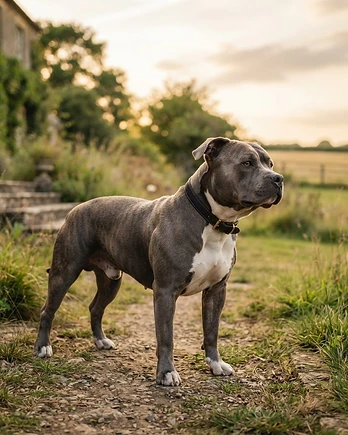
An American Bully in a proper show stack position, illustrating the ABKC breed standard's requirements for head type, topline, chest width, shoulder layback, and rear angulation as evaluated in conformation competition.
Registration Bodies: ABKC vs. UKC
American Bully Kennel Club (ABKC)
Founded in 2004, the ABKC is the breed-specific registry for the American Bully. It maintains the official breed standard, sanctions conformation shows, and issues pedigree certificates. ABKC registration is the gold standard for American Bully breeders and buyers who prioritize breed integrity. Registration requires both parents to be ABKC-registered, and litters are recorded with individual puppy certificates.
United Kennel Club (UKC)
The UKC granted American Bully breed status in 2013. As a multi-breed registry with a long history (founded 1898), UKC recognition added significant credibility to the breed. UKC-registered American Bullies can participate in UKC conformation events and performance events. Some nuances exist between the UKC and ABKC standards — notably the UKC's acceptance of the merle pattern.
Why Dual Registration Matters
At American Bully Haven Pups, all of our breeding dogs and litters are registered with both ABKC and UKC, providing buyers maximum flexibility and validation. Learn more about our breeding program and our commitment to ethical, standard-compliant breeding.
American Bully vs. Related Breeds: Key Differences
A persistent source of confusion — and unfortunately, a driver of breed-specific legislation — is the conflation of the American Bully with related breeds.
| Feature | American Bully | American Pit Bull Terrier | American Staffordshire Terrier | American Bulldog | |---------|---------------|--------------------------|-------------------------------|------------------| | AKC Recognition | No | No | Yes | No | | UKC Recognition | Yes (2013) | Yes | Yes | Yes | | Primary Purpose | Companion | Working/sport | Show/companion | Working/guardian | | Build | Heavy, wide | Athletic, lean | Moderate | Large, powerful | | Prey Drive | Low–moderate | High | Moderate | Moderate | | Avg. Male Weight | 60–120 lbs (varies by class) | 35–65 lbs | 55–70 lbs | 75–125 lbs | | Head Type | Blocky, broad | Wedge-shaped | Broad, round | Square, boxy |
The most important distinction: The American Bully was selectively bred to reduce terrier drive and increase companion qualities. A well-bred American Bully should not exhibit the high-energy, independent stubbornness of a working APBT.
Health Considerations and Responsible Breeding
American Bullies are generally robust dogs, but responsible breeding requires proactive health screening. Key health considerations include:
- Hip and Elbow Dysplasia: Evaluated via OFA (Orthopedic Foundation for Animals) hip and elbow radiographs. Hip dysplasia affects an estimated 20–30% of bully-type breeds when breeding pairs are not screened. OFA Excellent, Good, or Fair ratings are the minimum standard for ethical breeding pairs.
- Cardiac Evaluation: OFA cardiac clearance by a board-certified veterinary cardiologist screens for congenital heart defects including aortic stenosis.
- Eye Certification: CAER (Companion Animal Eye Registry) eye exams by a board-certified veterinary ophthalmologist screen for hereditary eye conditions.
- Cerebellar Ataxia (CA): A genetic neurological condition identified in American Bullies; DNA testing (available through UC Davis Veterinary Genetics Laboratory and Embark) can identify carriers and affected dogs.
- Brachycephalic Obstructive Airway Syndrome (BOAS): Dogs with excessively short muzzles may experience breathing restriction. Responsible breeders select for adequate muzzle length within the ABKC standard.
- Skin Conditions: Demodex mange and environmental allergies (atopic dermatitis) are more prevalent in bully breeds; proper nutrition, parasite prevention, and immune system support are important.
For comprehensive guidance on health care, nutrition, vaccination schedules, and veterinary partnerships across every life stage, read The Complete American Bully Care Guide: Puppyhood to Senior Years.
What Makes the American Bully Distinct
Beyond conformation and pedigree, the American Bully occupies a unique cultural and emotional space in the dog world. This is a breed that was born from community — from passionate breeders who wanted a dog that looked powerful but lived to love. The American Bully doesn't carry the baggage of a working or fighting history; it was purpose-built as a family companion from the very first generation.
Owners consistently describe their American Bullies as emotionally intuitive — dogs that sense stress, seek physical closeness, and adapt their energy to the household's mood. They are equally at home on a 5-mile hike and curled on the couch watching television. That versatility, combined with their striking visual presence and extraordinary affection, is why the American Bully has become one of the fastest-growing breeds in the United States.
For more in-depth resources across every aspect of ownership, visit our full resource library. You can also explore individual breed topics through our cluster articles: The Complete American Bully Breed Guide (Part 2), Part 3, Part 4, Part 5, Part 6, Part 7, and Part 8.
Key Takeaways
- The American Bully was developed in the late 1980s–early 1990s from American Pit Bull Terrier and American Staffordshire Terrier foundations, with intentional selection for companion temperament
- The ABKC recognizes four official varieties: Pocket, Standard, Classic, and XL — differentiated by height at the withers
- The ABKC breed standard prizes a broad skull, wide chest, heavy bone, level topline, and short, glossy coat
- All colors are permitted under ABKC rules except merle, which is a disqualification
- Core temperament traits include human affection, gentleness with children, social confidence, and low-to-moderate prey drive
- Foundational bloodlines including Razor's Edge and Gottiline shaped the modern breed's phenotype
- ABKC (2004) and UKC (2013) are the primary registration bodies; dual registration provides maximum credibility
- Responsible breeders conduct OFA hip/elbow, cardiac, eye, and genetic (Cerebellar Ataxia, DNA color) health testing
- The American Bully is not the same breed as the American Pit Bull Terrier — it is a distinct, purpose-bred companion dog
Frequently Asked Questions
Is the American Bully the same as a Pitbull?
No — and this distinction matters enormously. The American Pit Bull Terrier is a distinct breed with a working-dog heritage, higher prey drive, and leaner, more athletic build. The American Bully was developed from APBT genetics but was intentionally bred to reduce terrier characteristics and amplify companion traits. The two breeds have different body types, different temperament profiles, and separate breed standards and registries. Calling an American Bully a "Pitbull" is both inaccurate and contributes to the breed-specific legislation that affects so many families.
Are American Bullies good family dogs?
Absolutely — family compatibility is the breed's defining purpose. American Bullies are renowned for patience with children, deep affection for family members, and a socially confident disposition toward strangers when properly socialized. The ABKC standard explicitly disqualifies human aggression, meaning ethical breeders actively select against any aggressive tendency. Families with young children often find the breed's gentle, tolerant nature superior to many traditionally "family-friendly" breeds.
How much does an American Bully puppy cost?
Pricing varies significantly by variety, color, pedigree quality, and health testing. Well-bred Pocket Bullies from health-tested, dual-registered parents typically range from $3,500 to $10,000. Standard and Classic Bullies generally range from $2,500 to $7,000. XL Bullies from champion-pedigreed, health-screened parents can range from $3,000 to $15,000+. Exotic colors such as lilac tri, merle, and champagne carry premium pricing due to the genetics involved. Be cautious of prices that seem dramatically lower — they often indicate absent health testing, unregistered parents, or poor breeding conditions.
What health tests should a responsible American Bully breeder perform?
At minimum, ethical breeders should provide OFA hip and elbow evaluations (radiographic assessment graded by the Orthopedic Foundation for Animals), OFA cardiac clearance by a board-certified veterinary cardiologist, CAER eye certification, and DNA testing for Cerebellar Ataxia (CA) and genetic color panel. Embark or UC Davis Veterinary Genetics Laboratory are the industry-standard DNA testing providers. Always ask to see health certificates for both sire and dam before committing to a purchase.
What is the difference between a Pocket Bully and an XL Bully?
The primary difference is height and overall mass. Pocket Bullies stand under 17 inches (males) and typically weigh 30–55 lbs, while XL Bullies stand over 20 inches and typically weigh 80–150 lbs. Both carry the broad, muscular build characteristic of the breed, but the XL projects a dramatically larger physical presence. Temperament should be identical between varieties — gentle, affectionate, and family-oriented — when bred to standard.
Do American Bullies require a lot of exercise?
American Bullies are moderately active dogs. They benefit from 45–90 minutes of daily activity — typically two walks plus playtime — but are not the relentless working-dog athletes that some bully-type breeds can be. Their brachycephalic tendencies (in dogs with shorter muzzles) mean exercise should be moderated in extreme heat. Mental stimulation through training, puzzle feeders, and interactive play is equally important for their emotional wellbeing. Pocket Bullies adapt well to apartment living with consistent daily walks.
Ready to Meet Your American Bully?
If this guide has sparked excitement about welcoming an American Bully into your family, we'd love to be part of that journey. At American Bully Haven Pups in Austin, Texas, every puppy we raise is a reflection of everything described in this guide — correct conformation, verified health testing, and temperament we'd stake our reputation on.
Explore our available American Bully puppies, read through our adoption guide to understand our process, or simply contact us with your questions. We're breeders who genuinely love this breed — and we'd be honored to help you find your perfect match.