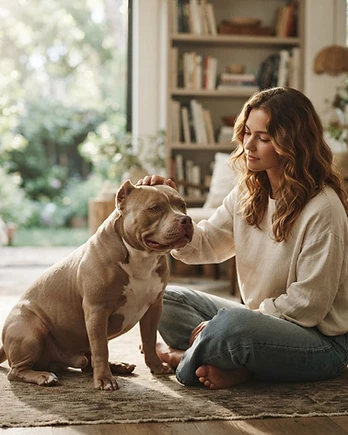
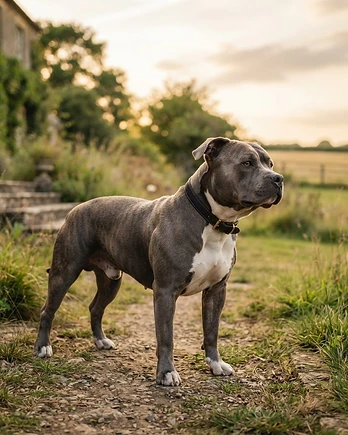
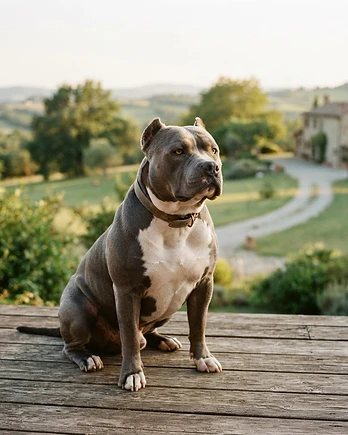
, which covers socialization, obedience, and positive reinforcement protocols specific to the breed's drives and learning style.
---
## American Bully vs. Related Breeds: Key Distinctions
Confusion between the American Bully and related breeds is extremely common — even among experienced dog people. Here's a clear breakdown:
| Feature | American Bully | American Pit Bull Terrier | American Staffordshire Terrier | American Bulldog |
|---|---|---|---|---|
| Body Type | Compact, heavily muscled | Athletic, lean-muscular | Medium-muscular | Large, powerful |
| Head | Very broad, blocky | Wedge-shaped | Broad, but less extreme | Large, square |
| Temperament | Companion-focused | Working/companion | Companion | Working/companion |
| Energy Level | Moderate | High | Moderate-high | Moderate-high |
| ABKC Recognized | Yes | No | No | No |
| Height (male) | 13–23 in (by variety) | 18–21 in | 18–19 in | 22–27 in |
The critical distinction: the American Pit Bull Terrier was developed for working utility and retains higher prey drive and energy. The American Bully was *intentionally bred away* from those traits toward a lower-drive, higher-affection companion profile. They share ancestry but serve different purposes.
---
## Health Considerations and Responsible Testing
Responsible American Bully breeding demands rigorous health testing. The breed is predisposed to several conditions that ethical breeders proactively screen for:
- **Hip Dysplasia:** OFA hip radiographs or PennHIP evaluations are standard; XL dogs face elevated risk due to their size
- **Elbow Dysplasia:** OFA elbow evaluation recommended for all breeding dogs
- **Congenital Heart Disease:** Cardiac evaluation by a board-certified cardiologist; the breed can be predisposed to aortic stenosis
- **Hypothyroidism:** OFA thyroid panel recommended
- **Eye Conditions:** CAER (Companion Animal Eye Registry) examination annually for breeding dogs
- **Brachycephalic Obstructive Airway Syndrome (BOAS):** More common in dogs with extreme head and muzzle conformation; requires veterinary evaluation
- **Skin Conditions:** Allergies, demodectic mange, and skin fold dermatitis are documented in the breed
For comprehensive guidance on keeping your American Bully healthy from puppyhood through the senior years, explore our [Complete American Bully Care Guide: Puppyhood to Senior Years](https://americanbullyhavenpups.com/resources/the-complete-american-bully-care-guide-puppyhood-to-senior-y-6).
At American Bully Haven Pups, all of our breeding dogs undergo OFA hip, elbow, cardiac, and eye evaluations before entering our program. You can learn more about our specific protocols by visiting [our breeding program page](https://americanbullyhavenpups.com/about).
---
## Registration Bodies: ABKC, UKC, and Beyond
- **ABKC (American Bully Kennel Club):** The breed's founding registry, established 2004. Governs the conformation standard, show circuit, and litter/individual registration. The ABKC is the gold standard for breed-specific registration.
- **UKC (United Kennel Club):** Recognized the American Bully in 2013. One of the oldest all-breed registries in the U.S. (founded 1898). UKC registration opens access to performance events, conformation shows, and breeding records.
- **BBCR (Bully Breed Coalition Registry):** An additional registry used by some breeders
- **International Registries:** The ABKC has affiliate show circuits in Europe, Asia, Latin America, and Australia, reflecting the breed's global growth
For buyers, ABKC and/or UKC dual registration is the preferred standard of quality. Always request registration papers and verify them with the relevant registry before purchasing.
---
## Key Takeaways
- The American Bully was intentionally developed in the late 1980s–1990s from APBT and AmStaff foundation stock, with molosser influence to enhance compact musculature and companion temperament
- Four official ABKC varieties exist: Pocket, Standard, Classic, and XL — differentiated by height, not weight
- The ABKC conformation standard prizes a broad skull, blocky muzzle, well-muscled body, and sound movement above all
- Coat colors span the full genetic spectrum: blue, chocolate, lilac, tri-color, merle, brindle, and more — responsible breeders DNA-test all color claims
- Merle breeding is safe only when merle × non-merle; merle × merle pairings risk producing deaf/blind double-merle offspring
- Temperament is the breed's crown jewel: stable, affectionate, human-oriented, and low aggression; human aggression is a serious fault
- Responsible health testing (OFA hips, elbows, cardiac, CAER eyes) is non-negotiable in ethical breeding programs
- ABKC and UKC registration are the dual gold standards for verified American Bully pedigrees
---
## Frequently Asked Questions
### Is the American Bully the same as a Pit Bull?
No — though they share ancestry, the American Bully and the American Pit Bull Terrier are distinct breeds with different registries, conformation standards, and breeding objectives. The American Bully was selectively developed to reduce the APBT's working drive and amplify its companion qualities, resulting in a broader, heavier, lower-energy dog. The term "Pit Bull" is itself an informal umbrella label, not a single recognized breed. American Bullies are registered with the ABKC and UKC, which maintain separate standards from ADBA- and UKC-registered APBTs.
### Are American Bullies aggressive or dangerous?
When correctly bred and properly socialized, American Bullies are among the most stable and affectionate dogs in existence. The ABKC standard explicitly states that human aggression is a disqualifying fault — it is bred *against*, not for. Like all dogs, individual temperament can be affected by poor breeding, inadequate socialization, or abusive handling. Choosing an ABKC/UKC registered breeder who health- and temperament-tests their dogs is the single most important step toward a safe, stable companion.
### How much does an American Bully puppy cost?
Quality, registered American Bully puppies from health-tested parents typically range from **$2,500 to $10,000+**, depending on variety (Pocket and XL tend to command the highest prices), coat color (lilac, merle, and tri combinations are premium), pedigree, and the breeder's show record and health testing investment. Significantly cheaper puppies (under $1,500) often indicate unregistered, untested, or poorly bred dogs. Explore [our available American Bully puppies](https://americanbullyhavenpups.com/puppies) to see current pricing and availability.
### What size American Bully is right for my family?
All four varieties share the same gentle, family-oriented temperament, so size is largely a lifestyle consideration. Pocket Bullies are ideal for apartment dwellers or those who prefer a more manageable size. Standard and Classic Bullies offer the classic breed look with versatile adaptability. XL Bullies are magnificent family companions but require more space, more food (and therefore greater expense), and more diligent health monitoring. Our [adoption guide](https://americanbullyhavenpups.com/adoption-guide) walks through how to match your lifestyle to the right variety.
### What is a "Micro Bully" and is it ABKC-recognized?
The "Micro Bully" or "Exotic Bully" refers to dogs bred for extreme size reduction and exaggerated features beyond the Pocket standard. The ABKC does **not** recognize the Extreme/Exotic or Micro categories, and many veterinary professionals have raised welfare concerns about health issues in extremely exaggerated specimens (severe BOAS, joint problems, shortened lifespans). The American Bully Exotic Registry (ABER) and other bodies exist for these types, but they are outside the ABKC breed standard. Ethical breeders working within ABKC guidelines do not produce Micro or Extreme-type dogs.
### How long do American Bullies live?
The average lifespan of an American Bully is **10–13 years** for Pocket, Standard, and Classic varieties. XL Bullies, like most giant breeds, tend toward the lower end — **8–10 years** — making health testing, appropriate nutrition, and weight management especially important for that variety. Genetics, health testing of parents, diet quality, exercise, and veterinary care all substantially influence individual longevity. Our [Complete American Bully Care Guide](https://americanbullyhavenpups.com/resources/the-complete-american-bully-care-guide-puppyhood-to-senior-y-5) covers lifespan optimization in detail.
---
## Your Journey Starts Here
The American Bully is more than a breed — it's a community, a commitment, and for those who truly know them, an irreplaceable presence in daily life. These dogs give everything: every wag, every lean, every velvet-headed nudge says *I am yours and you are mine*. That's not marketing. That's the breed.
At American Bully Haven Pups, every litter we produce reflects years of study, careful selection, rigorous health testing, and genuine love for this breed. We are ABKC- and UKC-registered, based in Austin, Texas, and committed to placing structurally sound, temperamentally exceptional puppies in homes that will cherish them.
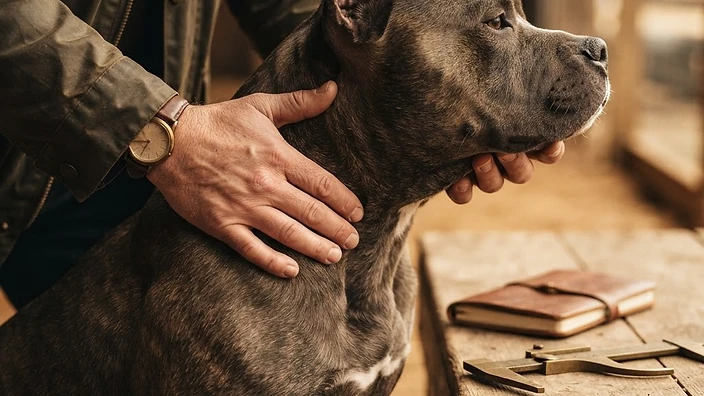
Browse [our available American Bully puppies](https://americanbullyhavenpups.com/puppies) — including [Diesel](https://americanbullyhavenpups.com/puppies/diesel-chocolate-tri), [Atlas](https://americanbullyhavenpups.com/puppies/atlas-lilac-tri-color), [Bowie](https://americanbullyhavenpups.com/puppies/bowie-blue-tri), [Hazel](https://americanbullyhavenpups.com/puppies/hazel-merle), and [Ella](https://americanbullyhavenpups.com/puppies/ella-lilac-tri) — or explore our [full resource library](https://americanbullyhavenpups.com/resources) for more in-depth guides. When you're ready to take the next step, we'd love to hear from you — [contact us](https://americanbullyhavenpups.com/contact) anytime.](https://media.base44.com/images/public/6a97812e2b63fe656e7233d7/7926864bf_generated_image.png/v1/fill/w_704,h_396,al_c,q_90,usm_0.66_1.00_0.01,enc_webp,quality_auto/7926864bf_generated_image.webp "The Complete American Bully Breed Guide: Everything You Need to Know")
Few dog breeds inspire as much passion, loyalty, and devoted community as the American Bully. From the moment you lock eyes with one — that broad, confident head, the muscular yet compact frame, the tail wagging with unrestrained enthusiasm — something clicks. These dogs are simultaneously powerful and gentle, imposing and affectionate, athletic and cuddly. They are, in a word, extraordinary.
Yet despite their surging popularity, the American Bully remains one of the most misunderstood breeds in the world. Misconceptions about aggression, confusion with related bully breeds, and misinformation about coat colors and registration abound. That's exactly why we created this guide. As ABKC- and UKC-registered breeders based in Austin, Texas, we've dedicated ourselves to this breed — and to giving future owners the accurate, complete knowledge they deserve.
Whether you're researching the breed for the first time or deepening your understanding before welcoming a puppy home, this is the most comprehensive American Bully resource you'll find anywhere. We'll cover every aspect: origin and development history, the four official size classes, ABKC conformation standards, coat color genetics, influential bloodlines, registration bodies, health considerations, and how this breed truly differs from its close relatives. Let's begin.
Origin and History of the American Bully
The American Bully is a deliberately developed breed, not an accident of circumstance. Its formal development began in the late 1980s and continued through the 1990s, primarily on the East Coast and West Coast of the United States. The foundational stock was the American Pit Bull Terrier (APBT) and the American Staffordshire Terrier (AmStaff), both of which contributed athleticism, loyalty, and structural integrity.
However, early breeders had a specific vision: they wanted to amplify the APBT's legendary devotion and stability while softening its working-dog drive and introducing a more compact, heavily muscled silhouette. To achieve this, select breeders incorporated genetics from several molosser-type breeds, most notably the American Bulldog, English Bulldog, and — in some lines — the Staffordshire Bull Terrier. The Olde English Bulldogge is also referenced in some historical accounts of early breeding programs.
The result was a dog that looked distinctly different from its APBT ancestors: shorter-legged, broader-chested, with a more pronounced head and a temperament calibrated for companionship rather than working utility. By the mid-1990s, a distinct community of breeders had coalesced around this new type.
The Founding of the ABKC
In 2004, the American Bully Kennel Club (ABKC) was established by Dave Wilson (of Razor's Edge fame) and Carlos Barksdale to formally recognize and register the American Bully as a distinct breed. The ABKC created the first official breed standard, defined the four size varieties, and established a conformation show circuit that has since grown into a global community.
In 2013, the United Kennel Club (UKC) — one of the oldest and most respected all-breed registries in the world — officially recognized the American Bully, lending the breed additional institutional credibility and opening new avenues for performance competition.
Today, the American Bully is recognized by the ABKC, UKC, and numerous international registries, with a dedicated show circuit, health testing protocols, and a passionate global community of breeders and owners.
The Four Size Varieties: Pocket, Standard, Classic, and XL
One of the most defining — and frequently misunderstood — aspects of the American Bully is its official size classification system. The ABKC recognizes four distinct varieties, differentiated primarily by height at the withers. Crucially, these are varieties of the same breed, sharing the same conformation standard and temperament expectations — size is the primary differentiating factor.

A comparative visual of the four American Bully size varieties — Pocket, Standard, Classic, and XL — illustrating the differences in height, body mass, and overall silhouette as defined by the ABKC breed standard.
Pocket Bully
- Height: Males under 17 inches at the withers; females under 16 inches
- Weight: Typically 11–22 kg (25–50 lbs), though no weight limit is specified in the standard
- Overview: The Pocket is the smallest variety but should never appear frail or weedy. Despite the name, there's nothing small about the Pocket's muscle mass, head structure, or presence. Pocket Bullies are among the most popular variety in the show community, prized for their compact power and manageable size. They tend to be highly sought after, often commanding prices between $3,000 and $8,000+ for quality, registered specimens.
Standard Bully
- Height: Males 17–20 inches; females 16–19 inches
- Weight: Typically 30–40 kg (65–85 lbs)
- Overview: The Standard represents the breed's original proportions — the benchmark against which all other varieties are measured. A correct Standard Bully should exhibit equal parts substance and athleticism, with a defined neck, well-sprung ribs, and pronounced muscle tone throughout. This is the variety most frequently shown in ABKC and UKC conformation events.
Classic Bully
- Height: Same height ranges as Standard
- Weight: Lighter body frame than Standard, typically 25–35 kg
- Overview: The Classic is perhaps the most misunderstood variety. It shares the Standard's height parameters but carries a lighter body frame, showing less exaggerated muscle mass. The Classic more closely resembles the American Pit Bull Terrier in body composition, serving as a bridge between the APBT's athleticism and the Bully's hallmark temperament. Classic Bullies often exhibit exceptional agility alongside the breed's characteristic gentleness.
XL Bully
- Height: Males over 20 inches (up to 23 inches); females over 19 inches (up to 22 inches)
- Weight: Typically 45–60 kg (100–130 lbs)
- Overview: The XL is the largest variety and commands immediate attention. Despite their imposing size, correctly bred XL Bullies are docile, gentle giants — exemplary family companions. Health considerations around joint integrity and cardiac function are especially important in XL dogs, making responsible health testing non-negotiable in ethical XL breeding programs.
| Variety | Male Height | Female Height | Approx. Weight | |---------|------------|---------------|----------------| | Pocket | < 17 in | < 16 in | 25–50 lbs | | Standard | 17–20 in | 16–19 in | 65–85 lbs | | Classic | 17–20 in | 16–19 in | 55–75 lbs | | XL | 20–23 in | 19–22 in | 100–130 lbs |
ABKC Conformation Standard: What Makes a Quality American Bully
Understanding the ABKC conformation standard is essential for evaluating any American Bully, whether you're a buyer, breeder, or exhibitor. The standard describes the ideal specimen across multiple anatomical categories.
Head and Expression
The American Bully's head is one of its most defining features. The standard calls for a large, broad skull with well-defined, prominent cheek muscles (zygomatic arch). The stop (the depression between the forehead and muzzle) should be moderate to well-defined. The muzzle should be broad and blocky — medium in length, neither too long nor too short — with a full, deep underjaw. The lips should be semi-close and even. Ears may be natural or cropped; both are accepted under the ABKC standard. Eyes should be round to oval, set low and wide, and any color is acceptable except albinism.
Neck, Body, and Topline
The neck should be heavy, slightly arched, tapering from the shoulders to the head, with no looseness of skin. The topline (the line from withers to tail set) should be level or show a very slight slope — not roached or swayed. The chest must be broad, deep, and full, with well-sprung ribs that give the dog impressive thoracic volume. The tuck-up (the underline from chest to flank) should be moderate.
Limbs and Movement
Forelegs must be straight and strong, with moderate bone. Hindquarters should show well-defined, muscular thighs. Movement should be smooth and effortless — the dog should cover ground efficiently with a confident, purposeful gait. Structural soundness directly correlates with long-term joint health, which is why ethical breeders prioritize OFA (Orthopedic Foundation for Animals) hip and elbow evaluations.
Coat and Color
The coat is short, close, stiff to the touch, and glossy. Any color, color pattern, or combination of colors is acceptable under the ABKC standard, with the exception of merle — which the ABKC does not currently recognize as a standard color (though merle Bullies exist and are registered by other bodies). This is a nuanced point we'll explore in the coat genetics section below.
Coat Colors and Genetics: The Full Spectrum
The American Bully exhibits one of the most diverse coat color palettes in the canine world. Understanding the genetics behind these colors helps buyers evaluate breeders' claims and understand why certain color combinations command premium prices.

A group of American Bully puppies displaying a range of coat color expressions including lilac tri, blue tri, chocolate tri, and merle, illustrating the breed's rich genetic diversity in pigmentation produced by K locus, A locus, dilute, and merle gene interactions.
Foundation Colors
- Black: Dominant base color; produced by the ASIP/K locus expression of eumelanin
- Blue: A dilution of black, produced by two copies of the dilute gene (d/d) at the MLPH locus; ranges from steel blue to soft blue-gray
- Chocolate (Brown/Liver): Produced by the b/b recessive genotype at the TYRP1 locus, which dilutes black eumelanin to brown
- Lilac: A double dilution — both chocolate (b/b) and blue (d/d) — producing a distinctive silvery-purple hue; one of the most sought-after colors
- Red/Fawn: Produced by phaeomelanin expression when the e/e recessive at the MC1R locus masks all eumelanin
- Brindle: A striping pattern produced by the kbr allele at the K locus, overlaid on a base color
Tri-Color Pattern
Tri-color Bullies carry the tan point pattern (expressed as the at/at genotype at the ASIP/A locus), which adds clearly defined tan, rust, or cream markings above the eyes, on the cheeks, chest, legs, and under the tail. Combined with any base color, tri-color produces some of the breed's most visually striking specimens — including blue tri, chocolate tri, lilac tri, and black tri.
Our own puppies showcase this genetic diversity beautifully. Diesel — Chocolate Tri Male American Bully puppy carries the rich chocolate base with classic tri-point markings, while Atlas — Lilac Tri-Color Male American Bully puppy expresses that rare double-dilute lilac with stunning tri points. Bowie — Blue Tri Male American Bully puppy demonstrates the elegant blue dilution paired with tan points, and Ella — Lilac Tri Female American Bully puppy is a breathtaking example of lilac tri expression in a female.
Merle
Merle is produced by the PMEL17 (M locus) gene, which creates a mottled, patchy pattern of diluted and full-color pigment. In American Bullies, merle produces striking appearances — as seen in Hazel — Merle Female American Bully puppy. However, ethical breeding practice demands that merle-to-merle pairings are never performed, as double merle offspring (MM genotype) face serious health risks including blindness, deafness, and neurological deficits. Responsible merle breeding always pairs a merle dog (Mm) with a non-merle dog (mm).
Ghost/Cryptic Merle and Color Testing
Ghost merle (very faint merle expression) can make visual identification unreliable, which is why reputable breeders DNA color test all breeding dogs using panels from labs such as UC Davis Veterinary Genetics Laboratory or Embark. This eliminates unknowing merle-to-merle pairings.
Influential Bloodlines
Bloodlines are a foundational concept in the American Bully community. They represent genetic families developed by pioneering breeders, each with distinct traits in structure, size, and head type.
- Razor's Edge: Founded by Dave Wilson in Virginia; credited as one of the most influential early bloodlines, producing the characteristic wide chest and calm temperament that define the modern Bully
- Gottiline (Gotti): Developed by Richard Barajas around the dog