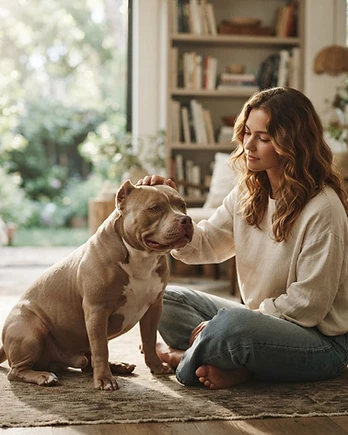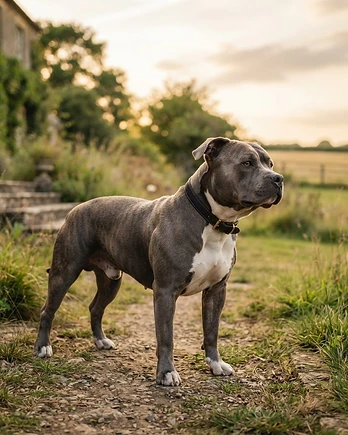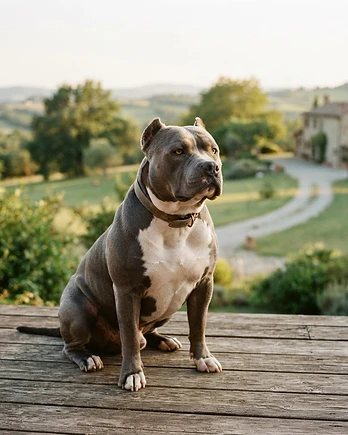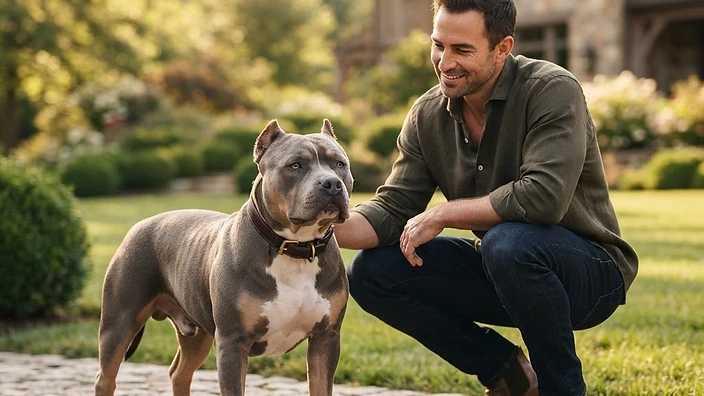
Few breeds have captured hearts and imaginations quite like the American Bully. In just three decades, this deliberately crafted companion has gone from a regional experiment to one of the most sought-after family dogs in the world — celebrated for a paradoxical combination of imposing physical presence and genuinely gentle, people-oriented temperament. Whether you're a lifelong Bully enthusiast or someone just beginning to research whether this breed is right for your family, you've found the right place.
At American Bully Haven Pups, we've dedicated our program to breeding structurally correct, health-tested American Bullies that embody the breed standard in both body and soul. We're ABKC- and UKC-registered, based in Austin, Texas, and we believe an informed owner is the best kind of owner. This guide exists to give you the complete picture — the history, the science, the standard, and the lived experience of life with an American Bully.
Bookmark this page. Share it with your partner, your kids, your vet. This is the most comprehensive American Bully breed resource we know how to write, and we update it regularly as the breed evolves. You can also explore our full resource library for deep-dive articles on health, nutrition, training, and more.
Origin and History of the American Bully
The Foundation: 1980s–1990s
The American Bully emerged primarily in Virginia and Southern California during the late 1980s and early 1990s. Visionary breeders — most notably Dave Wilson of Razor's Edge Kennels and Richard Barajas of Gottiline — sought to create a companion dog that combined the loyal, human-focused temperament of the American Pit Bull Terrier (APBT) with a broader, more compact, heavily muscled physique better suited to family life.
The foundation breeds most widely documented in American Bully development include the American Pit Bull Terrier and the American Staffordshire Terrier. Select programs also incorporated contributions from the Staffordshire Bull Terrier, American Bulldog, English Bulldog, and in some lines, the Olde English Bulldogge — each contributing specific structural traits like wider chests, shorter muzzles, and heavier bone. The result was deliberately distinct from its ancestors: a dog bred exclusively for companionship, not for any working or sporting purpose.
Formal Recognition
The United Kennel Club (UKC) officially recognized the American Bully as a distinct breed in July 2013 — a landmark moment that separated the Bully from the APBT in formal registry records. The American Bully Kennel Club (ABKC), founded in 2004 by Dave Wilson and Carlos Barksdale, had already been registering and sanctioning Bully conformation events for nearly a decade before UKC recognition and remains the breed's primary registry and standard-setting body worldwide.
The Four ABKC-Recognized Size Varieties
One of the most common points of confusion for new enthusiasts is understanding that "American Bully" is not a single uniform size. The ABKC officially recognizes four size classes, each with its own height range at the withers and its own dedicated conformation class. Size is measured at the withers (top of the shoulder blades), not by weight alone.

A visual comparison of the four official American Bully size varieties recognized by the ABKC: Pocket, Standard, Classic, and XL. Each variety shares the same core conformation standard but differs significantly in height at the withers and overall body mass.
Pocket Bully
The Pocket Bully is the smallest variety. Males measure under 17 inches at the withers (typically 13–16 inches); females measure under 16 inches. Despite the name, these are dense, heavily muscled dogs — not small or fragile. Adults commonly weigh between 11 and 22 kg (25–50 lbs), though heavily structured individuals may exceed this. Pocket Bullies are among the most popular variety today, prized for their compact footprint in smaller living spaces without sacrificing the breed's signature look.
Standard Bully
The Standard is the original, prototypical American Bully. Males stand 17–20 inches at the withers; females stand 16–19 inches. This variety best represents the breed's intended balance of muscle, bone, and athleticism. Adults typically weigh between 25 and 40 kg (55–88 lbs) depending on structure and conditioning. If you want the quintessential Bully silhouette — broad chest, defined musculature, medium length — the Standard is the reference point.
Classic Bully
The Classic shares the same height parameters as the Standard but carries a lighter body frame with less overall body mass and less exaggerated features. Classic Bullies tend to show more of the American Pit Bull Terrier influence in their build — leaner, more athletic, longer-legged relative to their body. They appeal to owners who prefer the breed's temperament and history with a less extreme phenotype.
XL Bully
The XL Bully is the largest officially recognized variety. Males stand over 20 inches (typically 20–23 inches) at the withers; females stand over 19 inches. These are genuinely large dogs — males commonly weigh 45–65 kg (100–140 lbs) or more. XL Bullies retain all the breed's temperamental hallmarks but present on a grand, impressive scale. It is worth noting that the XL Bully has been a focal point of breed-specific legislation (BSL) discussions in the UK; prospective owners outside the US should verify local regulations.
| Variety | Male Height | Female Height | Typical Adult Weight | |---------|------------|--------------|---------------------| | Pocket | Under 17" | Under 16" | 25–50 lbs | | Standard | 17–20" | 16–19" | 55–88 lbs | | Classic | 17–20" | 16–19" | 50–80 lbs | | XL | Over 20" | Over 19" | 100–140+ lbs |
Note: The "Extreme" label sometimes seen in informal use is not a separate ABKC-recognized variety — it refers to heavily exaggerated structural traits within the Standard or XL class.
ABKC Conformation Standard: What Judges and Breeders Look For
Understanding the ABKC conformation standard is essential for evaluating breeding quality, whether you're a buyer, breeder, or show competitor. The standard describes an ideal specimen in every anatomical region.
Head and Skull
The American Bully head is a defining feature: large, broad, and blocky, with a pronounced stop (the angle between the forehead and muzzle). The skull should be wide between the cheeks, with well-developed cheek muscles. The muzzle is broad and deep — medium in length, neither excessively short (which causes brachycephalic issues) nor long and narrow. Lips are semi-close, clean. Eyes are set low and wide on the skull; any shape and color are acceptable except albinism. Ears may be natural or cropped.
Neck, Topline, and Body
The neck should be heavy, muscular, and slightly arched, tapering from the shoulders to the head. The topline (the dog's back profile) should be level to slightly sloping from withers to rump. The chest is defined by wide, deep ribbing and broad, well-sprung ribs. The chest width should equal or exceed the chest depth. The body is compact, with a broad, deep chest and a well-sprung ribcage. The back is strong and muscular; the loin is short and muscular.
Limbs and Movement
Fore legs are straight, with heavy bone density, set wide due to the broad chest. Pasterns are upright and strong. Hindquarters are well-muscled through the thighs with well-bent stifles and low hocks. Movement should be agile, springy, and purposeful — not labored or paddling. Sound structure directly influences longevity and quality of life, which is why ethical breeders prioritize OFA (Orthopedic Foundation for Animals) hip, elbow, and cardiac evaluations.
Coat
The coat is short, close, stiff to the touch, and glossy. No long-coated ("fluffy") American Bullies are recognized under the ABKC standard. Fluffy coat expression results from a recessive FGF5 gene variant and while these dogs can make wonderful companions, they are a disqualification in the show ring.
American Bully Coat Colors and Color Genetics
The American Bully is one of the most color-diverse breeds in existence. The ABKC accepts all colors and color patterns, making coat color genetics a major topic in breeding programs.

A showcase of American Bully puppies displaying rare and exotic coat color patterns produced through recessive color genetics, including lilac tri-color, blue tri, chocolate tri, and merle. These colors are accepted under the ABKC standard and represent some of the most sought-after expressions in the breed today.
Base Colors
- Black — dominant black (K^B locus)
- Blue — dilute black, produced by two copies of the dilution gene (d/d at the MLPH locus)
- Chocolate/Brown — recessive brown (b/b at the TYRP1 locus)
- Lilac — double dilute (both blue dilution d/d AND chocolate b/b), producing a soft grayish-lavender coat
- Champagne — dilute red/fawn (isabella-adjacent)
- Fawn/Red — phaeomelanin expression controlled at the A locus
- Brindle — striped pattern on fawn/red background, controlled by K^br allele
Pattern Modifiers
- Tri-color — tan point expression (black/tan, blue/tan, chocolate/tan, lilac/tan) from a^t/a^t at the ASIP locus. Our Atlas — Lilac Tri-Color Male and Ella — Lilac Tri Female are excellent examples of lilac tri expression, while Bowie — Blue Tri Male showcases the blue tri pattern and Diesel — Chocolate Tri Male demonstrates rich chocolate tri coloring.
- Merle — dappled pattern from the PMEL gene (M locus). Merle introduces random dilution patches on a base coat. Our Hazel — Merle Female is a beautiful example. Responsible breeders never breed merle to merle — double merle (MM) offspring face serious risks of blindness and deafness.
- Piebald/White Spotting — white markings from the MITF gene (S locus)
- Ghost Tan — minimal tan point expression producing very subtle points
A Note on Rare Color Ethics
"Rare" colors like lilac, merle, and champagne command significant price premiums — puppies from quality rare-color bloodlines can range from $3,500 to $10,000+. This has attracted unscrupulous breeders who prioritize color over structure and health. Always verify that color-focused breeders are also producing dogs that meet the conformation standard and completing health testing.
Influential American Bully Bloodlines
Bloodlines are the genetic lineages that shaped the modern American Bully. Understanding them helps buyers evaluate pedigrees intelligently.
Razor's Edge
Founded by Dave Wilson in Virginia, Razor's Edge is arguably the most foundational bloodline in the breed. These dogs established the breed's characteristic wide head, heavy bone, and gentle temperament. Nearly every modern American Bully traces back to Razor's Edge in some capacity.
Gottiline
Richard Barajas' Gottiline program — centered on the legendary sire Juan Gotty — popularized the extremely wide, blocky phenotype that defines many Pocket and Extreme-style Bullies today. Gottiline dogs are known for massive heads, short stature, and heavy muscle.
Remyline
Founded by Fabian Chichester, Remyline introduced exceptional athleticism paired with beautiful structure. The bloodline is especially prominent in the XL and Standard varieties and is known for producing consistent type across generations.
Kurupt Bloodline
Kurupt Farm, based in the UK, became globally influential through the XL Bully variety. The line is characterized by extreme size, wide frames, and loose, heavily-wrinkled head structure.
Other Notable Lines
- Miagi Bullies — known for clean, tight structure
- Dark Dynasty — associated with XXL size
- Mikeland — consistent Standard-type producers
American Bully Temperament: The Breed's True Identity
If you take nothing else from this guide, take this: the American Bully was purpose-bred to be a companion animal, and its temperament reflects that completely. The ABKC breed standard explicitly states that the American Bully should be confident, outgoing, stable, and gentle with people — including children.
Key Temperament Traits
- Human affiliation: American Bullies are intensely bonded to their families. They thrive on physical contact, proximity, and attention.
- Child-friendliness: Properly socialized American Bullies are famously tolerant and gentle with children, earning the informal title of "nanny dog" — though adult supervision is always recommended simply due to size.
- Low aggression toward people: Human aggression is a disqualifying fault under the ABKC standard. Any Bully showing unprovoked aggression toward people is considered non-conforming to breed type.
- Dog-to-dog socialization: American Bullies can show dog-selective tendencies, particularly intact males. Early, positive socialization is essential. They are not inherently dog-aggressive, but individual variation exists.
- Trainability: High food motivation and a strong desire to please make American Bullies highly trainable. They respond exceptionally well to positive reinforcement methods.
For a comprehensive look at raising a well-rounded Bully from puppyhood through adolescence and adulthood, explore our Complete American Bully Care Guide: Puppyhood to Senior Years.
How the American Bully Differs From Related Breeds
One of the most common misconceptions is conflating the American Bully with other bull-type breeds. Here's a clear comparison:
| Feature | American Bully | American Pit Bull Terrier | American Staffordshire Terrier | English Bulldog | |---------|---------------|--------------------------|-------------------------------|----------------| | Primary Purpose | Companion | Working/Sport | Show/Companion | Companion | | Build | Heavy, compact | Athletic, lean | Medium, muscular | Heavy, low | | Head Type | Blocky, wide | Wedge-shaped | Broad, round | Very broad, wrinkled | | Energy Level | Moderate | High | Moderate-High | Low | | ABKC Registered | Yes | No | No | No | | UKC Registered | Yes (separate) | Yes | No | No |
The American Bully is not an American Pit Bull Terrier. They share ancestry but have been selectively bred for distinctly different phenotypes and purposes. Breed-specific legislation that targets "pit bulls" sometimes incorrectly includes American Bullies; this is a legal and factual misclassification that responsible breeders and advocacy organizations work to correct.
Registration Bodies: ABKC vs. UKC
American Bully Kennel Club (ABKC)
Founded in 2004, the ABKC is the premier registry specifically for the American Bully. It maintains the official breed standard, sanctions conformation shows and events, and issues registration papers. ABKC registration is widely considered the gold standard in the Bully community. The ABKC also operates regional breed ambassadors and educational programs.
United Kennel Club (UKC)
The UKC, founded in 1898 and one of America's oldest all-breed registries, recognized the American Bully in 2013 under its Guardian Dog group. UKC registration is respected and opens additional show opportunities. Some breeders dual-register with both ABKC and UKC.
What Registration Means for Buyers
Registration papers confirm a dog's pedigree but do not guarantee health or quality. Always request OFA health testing documentation in addition to registration papers. At American Bully Haven Pups, every puppy comes with both ABKC and/or UKC registration, full health records, and a health guarantee. Learn more about our breeding program.
Health Considerations and Ethical Breeding Practices
The American Bully's dramatic conformation — wide chest, heavy bone, compact body — creates specific health considerations that every owner and buyer should understand.
Common Health Concerns
- Hip dysplasia — a malformation of the coxofemoral (hip) joint, especially prevalent in XL individuals. OFA hip evaluation (PennHIP or traditional) should be completed on all breeding animals.
- Elbow dysplasia — assessed via OFA elbow radiographs
- Brachycephalic obstructive airway syndrome (BOAS) — in dogs with shorter muzzles, stenotic nares and elongated soft palates can impair breathing. Ethical breeders select for adequate muzzle length.
- Cardiac conditions — including congenital heart defects; OFA cardiac evaluations recommended
- Skin conditions — including demodectic mange, allergic dermatitis, and skin fold dermatitis in dogs with excessive wrinkling
- Hypothyroidism — thyroid panel evaluation recommended in breeding animals
The ABKC and responsible breeders strongly advocate for OFA health testing as a baseline standard. For detailed guidance on caring for your Bully's health from puppyhood through the senior years, our Complete American Bully Care Guide covers every life stage in depth.
Key Takeaways
- The American Bully was developed in the late 1980s–90s from American Pit Bull Terrier and American Staffordshire Terrier foundations, with contributions from several other bull-type breeds.
- Four ABKC-recognized size varieties exist: Pocket, Standard, Classic, and XL — each with specific height requirements at the withers.
- The ABKC (founded 2004) is the breed's primary registry; the UKC recognized the breed in 2013.
- The breed standard demands a wide, blocky head, heavy bone, deep chest, and a short, glossy coat.
- American Bullies accept all coat colors; rare colors (lilac, merle, tri) command premium prices but must not come at the expense of structure and health.
- Human aggression is a disqualifying fault — this breed was purpose-designed for companionship, and temperament is paramount.
- OFA hip, elbow, and cardiac testing are the baseline health evaluations expected of ethical breeders.
- The American Bully is a distinct breed from the American Pit Bull Terrier and should not be subject to BSL targeting APBTs.
Frequently Asked Questions
Is the American Bully a dangerous breed?
No. The American Bully was purpose-bred to be a companion animal, and the ABKC breed standard explicitly disqualifies any dog showing unprovoked human aggression — it is a breed fault, not a breed trait. Multiple behavioral studies and veterinary organizations, including the American Veterinary Medical Association (AVMA), caution against breed-based risk assessments, noting that individual temperament, socialization, and owner responsibility are far stronger predictors of behavior than breed alone. American Bullies consistently rank as affectionate, stable, and people-loving in temperament evaluations. Any dog — of any breed — can develop behavioral issues without proper socialization and responsible ownership.
How much does an American Bully puppy cost?
Pricing varies significantly based on bloodline, size variety, color, structure quality, and the breeder's health testing investment. From reputable, health-testing breeders, expect to pay $2,500–$5,000 for a quality Standard or Pocket Bully. Rare-color puppies (lilac tri, merle) from championship bloodlines can range from $5,000–$10,000 or more. Be cautious of prices significantly below or above these ranges without clear justification — bargain prices often reflect absent health testing, and inflated prices don't always reflect quality. Always ask for OFA documentation, registration papers, and references.
What is the difference between a Pocket Bully and an XL Bully?
The difference is entirely one of size. A Pocket Bully male measures under 17 inches at the withers and typically weighs 25–50 lbs; an XL Bully male measures over 20 inches and commonly weighs 100 lbs or more. Both varieties conform to the same structural standard — wide head, heavy bone, broad chest — just at radically different scales. Temperamentally, there is no significant difference between the varieties. Your choice should be driven by your living situation, lifestyle, and personal preference rather than any assumption about temperament based on size.
Are American Bullies good with children?
American Bullies are widely regarded as one of the best family dogs available when properly bred and socialized. Their patient, tolerant temperament — combined with a deep desire to please and be close to their people — makes them naturally gentle around children. That said, responsible ownership requires that interactions between any large dog and young children be supervised, simply due to the physical size difference. A wagging, excited XL Bully can accidentally knock over a toddler with pure joy. Teach children how to interact respectfully with dogs, and supervise all interactions — not because the breed is dangerous, but because it's good practice with any large dog.
How do I know if a breeder is ethical and reputable?
Ethical breeders will: (1) complete OFA health testing on both parents and share results openly, (2) hold current ABKC and/or UKC registration for all breeding animals, (3) allow you to visit the facility and meet at least the dam, (4) ask you questions about your lifestyle and experience, (5) provide a written health guarantee and lifetime breeder support, (6) never have puppies "always available" — responsible programs have waiting lists. Red flags include no health testing, no registration papers, reluctance to share pedigree information, and pressure to purchase quickly. Use our adoption guide for a detailed buyer's checklist.
What is the lifespan of an American Bully?
The average American Bully lifespan is 10–12 years for Standard and Classic varieties. Pocket Bullies, being smaller, often live 12–13 years. XL Bullies tend toward the shorter end of the range at 8–10 years, consistent with the general pattern of larger dogs having shorter lifespans. Lifespan is directly influenced by genetics (health-tested lineage), weight management, veterinary care, and the absence of severe structural exaggeration. Dogs from health-tested lines that maintain ideal body condition consistently outlive breed averages.
Ready to Meet Your American Bully?
The American Bully is, at its core, a love story — a breed created specifically to give its family everything a dog can offer: loyalty, joy, physical presence, and an unshakeable bond. When bred ethically, health-tested, and socialized thoughtfully, they are simply extraordinary companions.
At American Bully Haven Pups in Austin, Texas, every puppy we produce is ABKC- and/or UKC-registered, health-tested, and raised with exactly the care and early socialization this breed deserves. Browse our available American Bully puppies to meet our current litter — including stunning rare-color individuals. When you're ready to take the next step, we'd love to hear from you. Contact us anytime — we're passionate about this breed and always happy to answer your questions.
For more in-depth guides across every aspect of American Bully ownership, explore our full resource library. This breed will change your life. We're here to make sure it changes it for the better.