Few breeds inspire the kind of instant awe — and instant misconception — that the American Bully does. One look at that broad, muscular frame, that wide blocky head, and those warm, soulful eyes, and you understand why this breed has captured the hearts of dog lovers across the world in just three decades. But beyond the stunning appearance lies a breed purpose-built for companionship: gentle, loyal, deeply affectionate, and surprisingly sensitive.
At American Bully Haven Pups in Austin, Texas, we've dedicated ourselves to producing ABKC- and UKC-registered American Bullies that are as sound in temperament as they are striking in structure. Over the years, we've fielded thousands of questions from prospective owners — about sizes, colors, bloodlines, registration, health, and what life with a Bully truly looks like. This guide is our answer to all of them.
Whether you're researching the breed for the first time or deepening your knowledge before bringing home a puppy, this is the most comprehensive American Bully resource we know how to write. Let's start at the beginning.
The Origin and History of the American Bully
The American Bully emerged in the United States during the late 1980s and early 1990s, primarily on the East and West Coasts. Breeders — most notably in Virginia and Los Angeles — set out to create a companion-focused dog that retained the athletic build and loyalty of the American Pit Bull Terrier (APBT) while dramatically amplifying its gentleness, sociability, and physical mass.
The foundational crosses drew heavily from the American Pit Bull Terrier and the American Staffordshire Terrier, with selective influence from the American Bulldog, English Bulldog, Olde English Bulldogge, and in some early lines, the Staffordshire Bull Terrier. Breeders weren't simply crossing dogs at random — they were selecting with laser focus for a wider chest, heavier bone, broader skull, and above all, a stable, human-friendly temperament.
The United Kennel Club (UKC) officially recognized the American Bully as a distinct breed in 2013, a landmark moment that validated decades of selective breeding work. The American Bully Kennel Club (ABKC), founded in 2004 by Dave Wilson and Carlos Barrera, had already been the breed's primary registry for nearly a decade by that point — establishing the breed standard, show circuit, and four official size varieties that define the breed today.
Today the American Bully is one of the fastest-growing breeds in the world, with a passionate global community of breeders, exhibitors, and owners spanning the United States, Europe, Asia, and beyond.
The Four Official Size Varieties
One of the most common points of confusion for newcomers is that "American Bully" isn't a single size — it's a breed with four officially recognized varieties, each with its own height parameters under the ABKC standard. Size variety is determined solely by height at the withers, not by weight.
Pocket Bully
- Males: Under 17 inches at the withers (typically 13–16 inches)
- Females: Under 14 inches at the withers
- The Pocket is the smallest variety but should have the same heavy bone, broad chest, and muscular build as larger varieties — just compressed into a smaller frame.
- Despite the name, Pocket Bullies are not small dogs in terms of mass; a well-built male can weigh 30–50 lbs.
Standard Bully
- Males: 17–20 inches at the withers
- Females: 16–19 inches at the withers
- The Standard is considered the foundation variety — the benchmark against which all other sizes are measured.
- Weight typically ranges from 50–80 lbs depending on structure and conditioning.
Classic Bully
- Same height parameters as the Standard variety
- The Classic is distinguished by a lighter body frame and less overall body mass — it more closely resembles the American Pit Bull Terrier in build while still conforming to Bully breed type in head structure and temperament.
- An important distinction: Classic is a structural subtype of Standard height, not a separate size tier.
XL Bully
- Males: Over 20 inches at the withers (typically 20–23 inches)
- Females: Over 19 inches at the withers
- The XL is the largest and most imposing variety. Despite their size, well-bred XL Bullies are known for being exceptionally gentle and calm.
- Weight can range from 80–150 lbs, though structure and conditioning matter more than raw weight in the show ring.
| Variety | Male Height | Female Height | Approx. Weight | |---------|-------------|---------------|----------------| | Pocket | Under 17" | Under 14" | 30–50 lbs | | Standard | 17–20" | 16–19" | 50–80 lbs | | Classic | 17–20" | 16–19" | 45–70 lbs | | XL | Over 20" | Over 19" | 80–150 lbs |
For a deeper dive into what to expect at each life stage across these varieties, explore The Complete American Bully Care Guide: Puppyhood to Senior Years.
Temperament: The Heart of the American Bully
If the American Bully's body is its billboard, its temperament is its soul — and it is extraordinary.
The breed was purpose-bred for companionship above all else. The ABKC breed standard explicitly describes the ideal American Bully temperament as: outgoing, stable, gentle with people, good-natured, funny, and highly adaptable. Aggression toward humans is considered a serious fault; human-directed aggression sufficient to threaten or injure is a disqualification in the show ring.
Key Temperament Traits
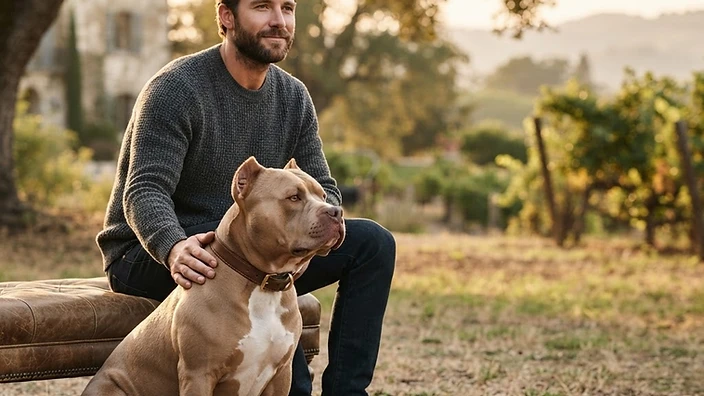
- Family devotion: American Bullies form deep, lasting bonds with their families. They are not aloof one-person dogs — they love everyone in the household, including children.
- Child-friendliness: Properly socialized Bullies are remarkably patient and gentle with children, earning the informal title "nanny dog" that has historically been applied to bully-type breeds.
- Sociability: Most American Bullies are genuinely happy to meet new people. Early socialization reinforces this natural openness.
- Sensitivity: Despite their tough appearance, Bullies are emotionally sensitive dogs. They respond poorly to harsh training methods and thrive with positive reinforcement.
- Moderate energy: American Bullies are athletic but not hyperactive. They enjoy exercise and play but are equally content to lounge on the couch with their family.
- Dog-dog interaction: Varies by individual and socialization history. Same-sex dog aggression can occur, particularly in intact males. Early socialization and proper introductions are essential.
For a structured approach to channeling these traits, see The Complete American Bully Training Guide.

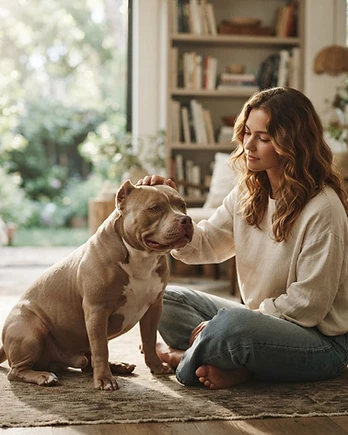
An American Bully interacting affectionately with a family, demonstrating the breed's hallmark stable, human-loving temperament that makes it an ideal companion for all ages.
The ABKC Conformation Standard
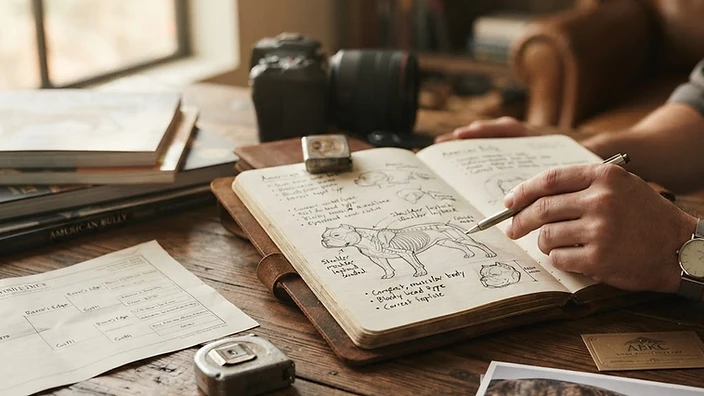
The American Bully Kennel Club (ABKC) breed standard is the definitive document governing what an American Bully should look and move like. Understanding it helps owners and buyers evaluate structural quality.
Head and Expression
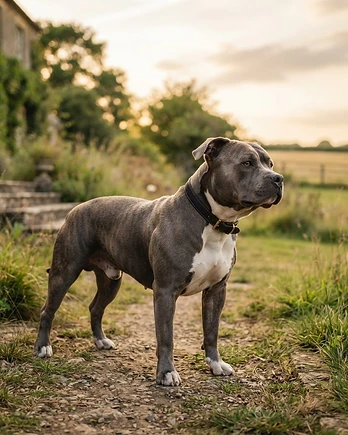
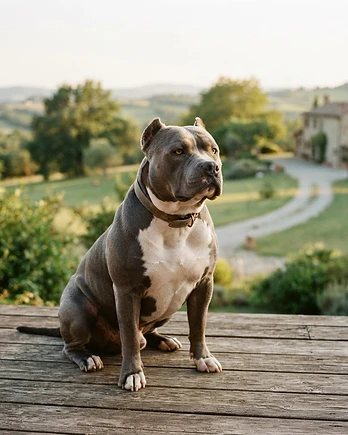
The skull is large, broad, and blocky — described as "massive" in relation to body size. The stop is well-defined. The muzzle is broad, deep, and short to medium in length. Cheek muscles are prominent. Eyes are low-set, round to oval in shape, and may be any color except albinism. Ears may be natural or cropped.
Neck, Topline, and Body
The neck is heavy, muscular, and slightly arched — tapering cleanly from shoulder to skull. The topline is level to very slightly sloping toward the rear. The chest is broad, deep, and well-sprung with prominent forechest. The back is strong and firm. The body is compact with a deep, muscular loin.
Forequarters and Hindquarters
Shoulder blades are wide, muscular, and well-laid back. The front legs are straight, strong, and wide-set. The hindquarters are broad, muscular, and well-developed with moderate angulation. Movement should be effortless and powerful — the gait of an athlete.
Coat and Skin
The coat is short, close, stiff to the touch, and glossy. Any color or pattern is acceptable under the ABKC standard — with one notable exception: merle is accepted in the American Bully, distinguishing it from some related breeds.
Size and Proportion
The body is slightly longer than tall, giving an impression of power and athleticism rather than square compactness. Proportion and balance are prized — excessive exaggeration that compromises function is faulted.
Coat Colors and Color Genetics
The American Bully's color genetics are among the most diverse and visually spectacular of any modern breed. Understanding the genetic basis helps buyers evaluate what they're seeing.
Base Colors
- Black (dominant black, K locus)
- Blue (dilute black — dd genotype at the D locus)
- Chocolate/Brown (bb genotype at the B locus)
- Lilac (double dilute: dd + bb — both blue and chocolate dilution)
- Red/Fawn/Buckskin (phaeomelanin expression with various intensity modifiers)
- Cream/White (extreme white or recessive red)
Pattern Overlays
- Tri-color: The highly sought-after tan point pattern (at locus — a^t a^t) creates distinct tan markings above the eyes, on the cheeks, chest, legs, and under the tail. Tri-color can appear on any base color, yielding Black Tri, Blue Tri, Chocolate Tri, and the extraordinarily rare Lilac Tri.
- Brindle: Tiger-stripe patterning produced by the K^br allele. Can appear on any base color.
- Merle: A mottled, dappled pattern caused by the M locus (PMEL17 gene). The ABKC accepts merle in American Bullies; however, double merle (MM) breeding is ethically prohibited due to severe health risks including blindness and deafness.
- Piebald/Parti: White spotting pattern from the S locus, producing parti-colored dogs with white patches.
- Ticking and roan: Fine spotting patterns within white areas.
Our current available puppies showcase the breed's genetic artistry beautifully. Meet Diesel — Chocolate Tri Male American Bully puppy, Atlas — Lilac Tri-Color Male American Bully puppy, Bowie — Blue Tri Male American Bully puppy, Hazel — Merle Female American Bully puppy, and Ella — Lilac Tri Female American Bully puppy.


A group of American Bully puppies displaying a range of coat colors and patterns including tri-color, merle, blue, and lilac, illustrating the remarkable genetic diversity within the breed.
Influential Bloodlines
Bloodlines in the American Bully world are more than marketing — they represent decades of selective breeding toward specific structural and temperament goals. Knowing the major bloodlines helps buyers understand a puppy's genetic heritage.
Razors Edge
Founded by Dave Wilson in the Washington D.C. area in the early 1990s, Razors Edge is widely considered the foundational American Bully bloodline. Wilson selected aggressively for heavy bone, wide chest, and calm temperament, producing dogs that became the template for the modern breed.
Gottiline
The Gottiline (or Gotti) bloodline traces to The Notorious Juan Gotty, a dog bred by Richard Barajas in Los Angeles that became one of the most influential sires in breed history. Gotti dogs are known for their extreme width, heavy mass, and short stature — heavily influencing the Pocket variety.
Remyline
Founded by Fabian Chichester, Remyline dogs are celebrated for their clean structure, athletic build, and exceptional temperament. The line has produced numerous champions and is respected for producing Bullies that are both show-quality and excellent family companions.
Kurupt Bloodline
Developed by Dax Ginn, the Kurupt line is known for producing dogs with exceptional color — particularly in the tri, lilac, and merle expressions — combined with heavy bone and compact build.
Other Notable Lines
- Mikeland — West Coast origin, known for mass and width
- Daxline — strong color genetics and structural integrity
- Watchdog Kennels — influential in the XL variety
- Muscle Up Kennels — noted for athletic build and temperament stability
At American Bully Haven Pups, our breeding program selects from proven bloodlines with documented health testing and verified registration — learn more by visiting our breeding program.
Registration Bodies: ABKC vs. UKC
Two primary registries govern the American Bully in the United States:
American Bully Kennel Club (ABKC)
Founded in 2004, the ABKC is the breed's primary and most specialized registry. It maintains the official breed standard, sanctions conformation shows, and provides pedigree registration specifically for American Bullies. ABKC registration is widely regarded as the gold standard for serious breeders and buyers.
United Kennel Club (UKC)
The UKC recognized the American Bully as a distinct breed in 2013 and offers registration, conformation shows, and performance events. The UKC operates a broader multi-breed registry, giving American Bullies access to a larger competitive circuit.
Both registries require three generations of documented pedigree for full registration. For a detailed breakdown of registration differences, costs, and what matters when buying a puppy, read ABKC vs UKC Registration: What Every Bully Owner Must Know.
American Bully vs. Related Breeds
The American Bully is frequently confused with several closely related breeds. Here's how to distinguish them:
| Breed | Key Differences from American Bully | |---|---| | American Pit Bull Terrier | Lighter, more athletic build; terrier energy; narrower head; recognized by UKC and ADBA, not AKC | | American Staffordshire Terrier | AKC-recognized; more refined build; less extreme head and body mass | | Staffordshire Bull Terrier | British origin; significantly smaller (24–38 lbs); more terrier-type head | | American Bulldog | Larger, taller, leggier; working-dog build; less compact | | English Bulldog | Heavier wrinkle; more extreme brachycephaly; much lower energy; AKC-recognized | | Micro/Exotic Bully | Not recognized by ABKC or UKC; often the result of extreme dwarfism; significant health concerns |
A critical misconception: the American Bully is not a Pit Bull. While it shares ancestry, it is a distinct breed with its own standard, registry, and breed purpose. Using the terms interchangeably does a disservice to both breeds and perpetuates misunderstanding.
Health Considerations and OFA Testing
Responsible American Bully breeding requires proactive health testing. The breed's structure — particularly its heavy, compact build — creates predispositions to certain conditions.
Common Health Concerns
- Hip dysplasia: A malformation of the hip joint, prevalent in heavily built breeds. OFA (Orthopedic Foundation for Animals) hip evaluations are the industry standard; preliminary radiographs can be taken at 4 months, with official certification at 24 months.
- Elbow dysplasia: OFA elbow evaluation recommended for all breeding stock.
- Brachycephalic obstructive airway syndrome (BOAS): Affects dogs with compressed skull anatomy. Not all American Bullies are brachycephalic, but dogs with very short muzzles should be evaluated.
- Hypothyroidism: OFA thyroid evaluation available.
- Hereditary cataracts and eye anomalies: CAER (Companion Animal Eye Registry) examination recommended.
- Cardiac conditions: OFA cardiac evaluation by a board-certified cardiologist.
- Ichthyosis: A skin condition affecting some bully-type breeds — genetic testing available.
- Cerebellar ataxia (CA) and Hyperuricosuria (HUU): Genetic conditions testable via DNA panels (Embark, Wisdom Panel).
Ethical breeders provide OFA health clearances, full pedigree documentation, and genetic testing results for all breeding animals. For comprehensive care guidance through every life stage, visit The Complete American Bully Care Guide: Puppyhood to Senior Years.
What Makes the American Bully Truly Distinct
Among the dozens of working and companion breeds developed in America, the American Bully occupies a unique space. It was bred with a single, unwavering purpose: to be the ultimate family companion. Not a guard dog. Not a working dog. Not a fighting dog. A companion — designed from the ground up to love people and be loved in return.
That intentionality shows in every aspect of the breed. The broad head and blocky body are striking, but they exist alongside a heart that is soft, open, and endlessly devoted. These are dogs that will lean against your legs, sleep at your feet, and follow you from room to room with an expression of complete contentment. They are clowns and cuddlers, athletes and lapdogs, all wrapped in one unforgettable package.
For first-time owners considering this breed, The First-Time American Bully Owner's Complete Guide is an excellent next read.
For nutrition guidance specific to this breed's unique dietary needs, see The Complete American Bully Nutrition Guide.
Key Takeaways
- The American Bully was developed in the late 1980s–early 1990s from American Pit Bull Terrier, American Staffordshire Terrier, and Bulldog crosses — purpose-bred for companionship.
- Four ABKC-recognized size varieties exist: Pocket, Standard, Classic, and XL — differentiated by height at the withers, not weight.
- Temperament is the breed's defining characteristic: stable, gentle, affectionate, and deeply human-focused. Human aggression is a serious fault.
- The ABKC (est. 2004) is the primary breed registry; the UKC recognized the breed in 2013.
- Coat color genetics are extraordinarily diverse — including tri-color, merle, lilac, blue, chocolate, and combinations thereof.
- Major bloodlines include Razors Edge, Gottiline, Remyline, and Kurupt — each with distinct structural and temperament contributions.
- The American Bully is not a Pit Bull — it is a distinct breed with its own standard and registry.
- Responsible breeding requires OFA hip, elbow, cardiac, and eye testing, plus DNA health panels.
- Ethical breeders provide full health documentation, ABKC/UKC registration papers, and socialization from birth.
Frequently Asked Questions
Is the American Bully a good family dog?
Absolutely — and by design. The American Bully was purpose-bred to be a companion animal, and its breed standard explicitly prizes a gentle, stable, human-loving temperament. When properly socialized and raised with consistent, positive training, American Bullies are extraordinarily patient with children, affectionate with all family members, and adaptable to a wide variety of living situations including apartments, provided they receive adequate daily exercise. Few breeds are as reliably devoted to their families.
What is the difference between a Pocket Bully and an XL Bully?
The difference is entirely in height. A Pocket Bully male stands under 17 inches at the withers; an XL Bully male stands over 20 inches. Both should have the same heavy bone, broad chest, and muscular build characteristic of the breed — the Pocket is not a miniaturized or less correct dog, simply a smaller one. Weight can range from roughly 30–50 lbs for a Pocket male to 80–150 lbs for an XL male, though body composition and structure are more important than raw weight.
How much does an American Bully puppy cost?
American Bully puppies from ethical, health-tested, ABKC/UKC-registered breeders typically range from $2,000 to $10,000+, with exotic or rare-color puppies from proven bloodlines sometimes reaching $15,000–$30,000 or more. Price reflects health testing, registration, bloodline quality, color genetics, structural merit, and the breeder's investment in socialization. Beware of puppies priced significantly below $1,500 — they frequently come without health testing, legitimate registration, or proper early development. For a full breakdown, read our American Bully Price Guide 2026: What to Expect & Why It's Worth It.
Are American Bullies banned or restricted?
Breed-specific legislation (BSL) varies by municipality, county, and country. Some jurisdictions ban or restrict "Pit Bull type" dogs, and American Bullies may be included depending on local definitions. Before acquiring an American Bully, verify the laws in your city and county, your homeowner's or renter's insurance policy, and any HOA restrictions. Responsible owners take this step before bringing a puppy home, not after.
What health tests should an American Bully breeder perform?
At minimum, ethical breeders should perform OFA hip evaluations, OFA elbow evaluations, OFA cardiac evaluations by a board-certified cardiologist, and CAER eye examinations on all breeding stock. DNA health panels (via Embark or Wisdom Panel) should screen for hereditary conditions including Hyperuricosuria (HUU), Hereditary Cataracts, Cerebellar Ataxia, and degenerative myelopathy where applicable. All results should be publicly verifiable through the OFA/CHIC database. Ask any breeder you're considering to provide documentation — a reputable breeder will offer it proactively.
How do I find a reputable American Bully breeder?
Start by looking for breeders registered with the ABKC or UKC, with verifiable pedigrees for both parents. Ask for OFA health clearances, visit (virtually or in person) the facility where puppies are raised, and evaluate the breeder's transparency and willingness to answer questions. Red flags include no health testing, no registration papers, reluctance to provide references, and puppies available at unusually low prices. Our adoption guide walks you through every step of the process.
Ready to Meet Your American Bully?
We hope this guide has given you a deep, honest, and inspiring picture of what the American Bully breed truly is — and why so many families fall irreversibly in love with them. If you've reached the end of this article, you're exactly the kind of thoughtful, informed future owner that a Bully deserves.
Explore our available American Bully puppies, browse our full resource library for more in-depth guides, or contact us directly — we'd love to talk about your family, your lifestyle, and which puppy might be the perfect match. At American Bully Haven Pups, every puppy leaves with a foundation of love, health, and a lifetime of support from our team.
The right Bully is out there. Let's find yours.