Few breeds inspire as much admiration — and as much misunderstanding — as the American Bully. With their broad, muscular frames, expressive faces, and remarkable gentleness toward people, these dogs occupy a unique space in the canine world: physically imposing yet emotionally soft, athletically powerful yet deeply family-oriented. Whether you've been drawn in by a photo of a blocky-headed Pocket Bully or you're researching the XL variety for a homestead companion, understanding this breed fully is the first step toward a lifetime of partnership.
At American Bully Haven Pups in Austin, Texas, we've spent years working with ABKC- and UKC-registered American Bullies. We've studied pedigrees, tracked bloodlines, whelped litters, and watched puppies grow into extraordinary family members. This guide distills everything we know — and everything the breed deserves — into one comprehensive, authoritative resource. It's the article we wish had existed when we started.
This is your definitive American Bully breed guide. Bookmark it, share it, and return to it whenever a question arises. And when you're ready to take the next step, we'd love to introduce you to our available American Bully puppies.
Origin and History of the American Bully
The American Bully is a surprisingly young breed, formally developed in the United States during the 1980s and 1990s. The breed emerged primarily on the East and West Coasts, with significant founding stock contributed by breeders in Virginia, California, and surrounding states. The goal was deliberate: create a companion dog that retained the loyalty, athleticism, and structural confidence of the American Pit Bull Terrier (APBT) while dramatically amplifying the breed's gentle, human-focused temperament and distinctive, heavily-muscled body type.
Founding Breeds and Genetic Contributions
The American Bully's genetic foundation is rooted in the American Pit Bull Terrier and the American Staffordshire Terrier (AmStaff) — both members of the broader "bully breed" family descended from 19th-century English bull-and-terrier crosses. However, to achieve the broader chest, heavier bone, and more compact build that defines the modern Bully, foundational breeders selectively introduced genetics from several other breeds, including:
- American Bulldog — contributing mass, bone density, and broad head structure
- English Bulldog — influencing the short muzzle, rose ear, and low-slung build seen in some lines
- Olde English Bulldogge — adding additional substance and wrinkle
- Staffordshire Bull Terrier — contributing the Pocket variety's compact stature
The exact blend varies by bloodline, but the result is a dog that is unmistakably its own breed — not a Pit Bull, not a Bulldog, but an American Bully.
Formal Recognition
The American Bully Kennel Club (ABKC) was established in 2004 as the breed's primary registry and conformation standard body, cementing the American Bully's identity as a distinct breed. The United Kennel Club (UKC) followed with official recognition in 2013. These registrations were landmark moments — they separated the American Bully from its APBT ancestors on paper and in the show ring, and they gave ethical breeders a framework for health testing, conformation judging, and lineage documentation. For a deep dive into how these registries compare, see our guide on ABKC vs UKC Registration: What Every Bully Owner Must Know.
The Four ABKC Size Varieties
One of the most distinctive features of the American Bully is that it is officially recognized in four size varieties, each with its own conformation standard. Understanding the differences is essential — not just for show competitors, but for prospective owners choosing the right fit for their home and lifestyle.

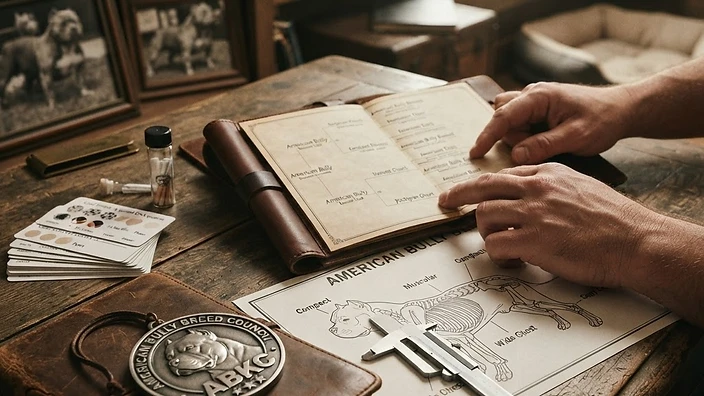
A comparative visual of the four official American Bully size varieties recognized by the ABKC — Pocket, Standard, Classic, and XL — illustrating the range of builds from the compact Pocket to the imposing XL Bully.
Pocket Bully
Height: Under 17 inches (males), under 16 inches (females) at the withers Weight: Typically 11–22 kg (25–50 lbs), though no weight disqualification exists — height governs class
The Pocket Bully is the most compact variety, but "pocket" is a misnomer if you imagine a tiny dog — these are dense, heavily-muscled animals packed into a shorter frame. The hallmark of a quality Pocket is extreme substance relative to height: broad chest, heavy bone, blocky head, and a short, tight back. They are enormously popular among apartment and urban dwellers because of their manageable size, but they carry the full personality and structural presence of the breed. For a detailed comparison, read our Pocket vs Standard Bully: Which Size Is Right for You? guide.
Standard Bully
Height: 17–20 inches (males), 16–19 inches (females)
The Standard variety is the "benchmark" of the breed — the size from which all other varieties are measured. Standard Bullies balance muscular mass with athletic functionality, exhibiting the breed's characteristic blocky head, wide chest, and powerful hindquarters without the extreme height of the XL or the compressed build of the Pocket. Most founding bloodlines were developed at the Standard size, making it historically central to the breed.
Classic Bully
Height: Same range as Standard (17–20 inches males, 16–19 inches females)
The Classic is often misunderstood. It shares the height parameters of the Standard but carries less overall body mass — a lighter, more athletic build that more closely resembles the American Pit Bull Terrier or AmStaff ancestors. The Classic was formally recognized to honor breeders who preferred a leaner, more functional phenotype without departing from Bully breed type. Classics tend to have more visible muscle definition, a slightly less exaggerated head, and a more moderate overall structure.
XL Bully
Height: Over 20 inches (males), over 19 inches (females)
The XL American Bully is the largest officially recognized variety. Males commonly stand 20–23 inches at the withers and can weigh 70–150+ lbs, depending on structure and conditioning. Despite their imposing size, quality XL Bullies are evaluated on the same proportionality standards as other varieties — mass must be balanced with structure, movement must be fluid, and temperament must remain gentle and people-friendly. XL Bullies have become extraordinarily popular in recent years, commanding some of the highest prices in the breed.
Size Variety Comparison
| Variety | Male Height | Typical Male Weight | Key Trait | |---------|------------|--------------------|-----------| | Pocket | Under 17" | 25–50 lbs | Maximum substance in minimum height | | Standard | 17–20" | 65–85 lbs | Balanced mass and athleticism | | Classic | 17–20" | 50–70 lbs | Leaner, more athletic build | | XL | Over 20" | 80–150+ lbs | Largest recognized variety |
ABKC Conformation Standard: What Judges Look For
The ABKC breed standard is the blueprint for the ideal American Bully. Understanding it helps owners evaluate quality and recognize ethical breeding priorities.
Head and Skull
The American Bully head is large, broad, and blocky — one of the breed's most defining features. The skull is broad between the cheeks, with well-defined cheek muscles. The stop (the transition between skull and muzzle) is moderate to pronounced. The muzzle is broad, deep, and shorter than the skull length, with a well-developed underjaw. Lips are semi-close and even. Eyes are oval to round, set low and wide. Ears can be natural (rose, semi-prick, or prick) or cropped — both are acceptable under ABKC standard.
Neck and Topline
The neck is heavy, muscular, and slightly arched — tapering cleanly from the shoulders to the back skull. The topline should be level to slightly sloping from withers to rump, with a broad, muscular back. Roach backs (upward-arching spine) or swaybacks are faults.
Body, Chest, and Ribcage
The chest is broad, deep, and well-filled — one of the breed's most visually striking features when viewed from the front. Ribs are well-sprung and the brisket (lower chest) drops to or below the elbow. The body is compact and relatively short-coupled.
Forequarters, Hindquarters, and Movement
Front legs are heavy-boned and straight, set wide. Shoulders are strong and muscular. Rear angulation is moderate with well-developed thighs. Movement should be smooth, effortless, and powerful — a loose or stilted gait is penalized.
Disqualifying Faults
Under ABKC standard, disqualifications include: merle coloration in some show contexts, unilateral or bilateral cryptorchidism, viciousness toward people, and extreme undershot or overshot bites exceeding ½ inch.
American Bully Temperament: The Truth Behind the Appearance
If there is one area where the American Bully is most consistently misunderstood, it is temperament. The breed's muscular physique triggers assumptions about aggression — assumptions that couldn't be further from the truth.
The American Bully was selectively bred for human affinity above all else. Founding breeders specifically culled any dog showing human-directed aggression from their programs. The result is a breed that is:
- Extraordinarily affectionate with family members of all ages
- Patient and tolerant with children — earning the nickname "nanny dog" in many circles
- Eager to please — highly trainable with positive reinforcement
- Confident but not combative — stable under pressure, not easily provoked
- Sociable with strangers when properly socialized from puppyhood
Dog-to-dog interaction varies by individual and bloodline. Some American Bullies are highly dog-social; others are selective. Early socialization and responsible ownership remain critical. But the idea that this breed is inherently aggressive toward people is a myth without genetic or behavioral support. For an in-depth look at the breed's family suitability, read Are American Bullies Good Family Dogs? Absolutely. Here's Why.

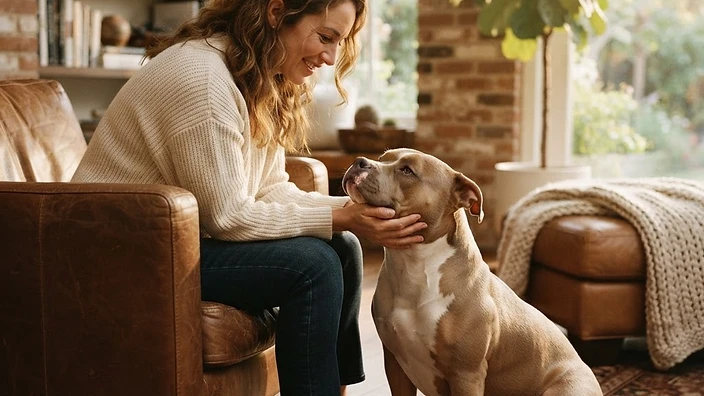
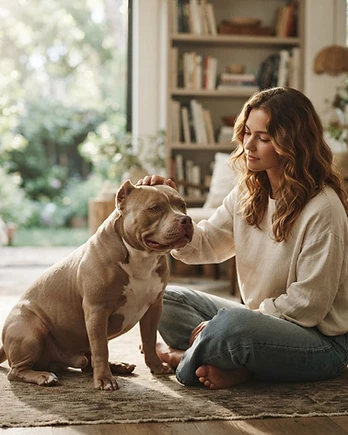
An American Bully relaxing comfortably with family members, demonstrating the breed's hallmark human-focused temperament — calm, affectionate, and deeply loyal. This image supports the temperament section of the American Bully breed guide.
American Bully Coat Colors and Genetics
The American Bully displays one of the most diverse color palettes of any breed. The ABKC accepts all coat colors and patterns with the exception of merle in certain show classes — making the Bully a canvas for extraordinary genetic expression.
Base Colors
Base coat color is determined by the E locus (extension), B locus (brown/chocolate), and K locus (dominant black) among others. Common base colors include:
- Black — classic and common; deep jet black with no brindle
- Blue — a dilution of black caused by the d allele (MLPH gene) on the D locus; ranges from steel blue to slate
- Chocolate (Brown) — a recessive mutation at the TYRP1 gene (B locus); warm brown base coat
- Lilac — the result of both blue and chocolate dilution genes acting simultaneously (dd + bb); a cool, dusty lavender-gray that is among the rarest base colors
- Fawn and Red — phaeomelanin-based colors ranging from light cream to deep mahogany
- Brindle — striped pattern of dark pigment over a lighter base; can occur in virtually any base color
Tri-Color Pattern
Tri-color Bullies carry the tan point pattern controlled by the atat genotype at the A (agouti) locus. This produces clearly defined points of tan/rust above the eyes, on the cheeks, chest, legs, and under the tail — similar to a Rottweiler or Doberman pattern. Tri-color can express over any base color, producing stunning combinations like:
- Blue Tri — blue base with tan points (see Bowie — Blue Tri Male American Bully puppy)
- Chocolate Tri — brown base with tan points (see Diesel — Chocolate Tri Male American Bully puppy)
- Lilac Tri — the rarest and most coveted combination (see Atlas — Lilac Tri-Color Male American Bully puppy and Ella — Lilac Tri Female American Bully puppy)
Ghost Tri and Tuxedo Patterns
Some tri-color dogs express ghost points — faint, barely visible tan markings — due to modifying genes that suppress point expression. Tuxedo pattern refers to a specific white marking distribution on the chest and feet.
Merle
Merle is a dominant patterning gene (M locus, PMEL17 gene) that creates a mottled, marbled coat of diluted and full-color patches. Merle Bullies are striking and highly sought after — see Hazel — Merle Female American Bully puppy for an example. However, breeding merle to merle (double merle) produces dogs at high risk of blindness, deafness, and neurological deficits — a practice all ethical breeders avoid absolutely. For the full breakdown of colors and genetics, explore our dedicated American Bully Coat Colors: Lilac, Blue, Tri & More Explained guide.
Influential American Bully Bloodlines
Understanding bloodlines is essential for evaluating pedigrees, predicting puppy traits, and identifying quality breeding programs. The following are among the most historically significant and widely recognized American Bully bloodlines:
Razors Edge
Founded by Dave Wilson in the Washington D.C. area during the 1980s–90s, Razors Edge is arguably the single most influential bloodline in American Bully history. Known for extreme width, heavy bone, blocky heads, and exceptional temperament, Razors Edge genetics appear in the pedigrees of countless modern Bullies across all size varieties.
Gottiline
Developed by Richard Barajas around a dog named "The Notorious Juan Gotty", the Gottiline bloodline revolutionized the Pocket Bully category. Gotty's offspring were extraordinarily wide, low-stationed, and heavily muscled — and his descendants are found throughout modern Pocket and Standard pedigrees.
Remyline
Founded by Fabian Chichester, Remyline contributed athletic, well-proportioned Bullies with excellent movement and structure. Remyline dogs are particularly noted for their balanced phenotype — not extreme in any one direction — making them highly influential in performance-oriented lines.
Mikeland
A West Coast bloodline known for producing heavy-boned, extremely wide Bullies with strong heads. Mikeland genetics contributed significantly to the development of the XL variety.
Kurupt Bloodline
The Kurupt bloodline, developed in part through Kurupt Farmboys in the UK, became internationally significant in XL Bully development, particularly in Europe. The influence of this line on the UK's recent XL Bully controversy — and subsequent breed-specific legislation — highlights how bloodline selection carries real-world consequences.
Other Notable Lines
Watchdog, Iron Cross, Kingpin, Daxline, and Bullycamp are among many other lines that have shaped specific phenotypic traits within the breed.
Registration Bodies: ABKC and UKC
Two primary organizations register American Bullies in the United States:
American Bully Kennel Club (ABKC)
The ABKC is the breed's founding registry, established specifically for the American Bully. It maintains the official breed standard, sanctions conformation shows, and issues registration papers for purebred American Bullies. ABKC registration requires both sire and dam to be ABKC-registered. The ABKC also runs the ABKC DNA program for parentage verification.
United Kennel Club (UKC)
The UKC recognized the American Bully in 2013 as part of its Companion Dog Group. UKC registration provides access to performance events and a secondary conformation standard. Some breeders dual-register litters with both ABKC and UKC.
Why Registration Matters
Registration is not merely paperwork — it is the infrastructure of ethical breeding. Registered dogs have documented pedigrees, enabling health trend tracking across generations. It also signals a breeder's commitment to breed standards and accountability. For a full comparison, see ABKC vs UKC Registration: What Every Bully Owner Must Know.
American Bully vs. Related Breeds
One of the most common points of confusion — and one of the most important to clarify — is how the American Bully relates to visually similar breeds.
| Feature | American Bully | American Pit Bull Terrier | American Bulldog | English Bulldog | |---------|---------------|--------------------------|------------------|-----------------| | Build | Extremely muscular, wide | Athletic, medium build | Heavy, tall | Low, compact | | Head | Blocky, very broad | Moderate, brick-shaped | Large, square | Massive, wrinkled | | Temperament | Human-focused, calm | Energetic, driven | Confident, loyal | Docile, stubborn | | Size | 11–150+ lbs (all varieties) | 30–65 lbs | 60–120 lbs | 40–55 lbs | | Registry | ABKC, UKC | UKC, ADBA | NKC, UKC | AKC | | Breed Origin | USA, 1980s–90s | USA/UK, 1800s | USA, 1800s | England, 1800s |
The American Bully is NOT an American Pit Bull Terrier — this is perhaps the single most important distinction to make. While they share ancestry, they have been independently developed, are registered separately, and have meaningfully different phenotypes and temperament profiles. Conflating the two contributes to breed-specific legislation missteps and unfair stigma.
Health Considerations for American Bullies
As a breed developed through selective crossbreeding, the American Bully carries some health predispositions that responsible breeders actively test for and work to reduce.
Common Health Concerns
- Hip and Elbow Dysplasia — given the breed's heavy mass relative to frame size, orthopedic health is critical. OFA (Orthopedic Foundation for Animals) hip and elbow evaluations are the gold standard
- Brachycephalic Obstructive Airway Syndrome (BOAS) — shorter muzzles in some lines can contribute to airway compromise; ethical breeders select against extreme facial compression
- Skin fold dermatitis — common in heavily-wrinkled dogs; managed with regular cleaning
- Cardiac conditions — including congenital heart defects; OFA cardiac screening is recommended
- Eye conditions — cherry eye, entropion; CAER (Companion Animal Eye Registry) exams are advisable
For detailed health guidance, visit The Complete American Bully Health Guide and The Complete American Bully Care Guide: Puppyhood to Senior Years.
What Does an American Bully Cost?
American Bully prices vary significantly based on variety, bloodline, color, and breeder reputation. As a general framework in 2025–2026:
- Standard/Classic Bullies from reputable breeders: $2,500–$6,000
- Pocket Bullies: $3,000–$8,000+
- XL Bullies: $3,500–$10,000+
- Rare-color Bullies (Lilac Tri, Merle): $5,000–$15,000+
- Championship-pedigreed or highly anticipated litters: $10,000–$30,000+
These prices reflect health testing, quality breeding stock, ABKC/UKC registration, early socialization programs, and breeder support. For a thorough breakdown, see our American Bully Price Guide 2026: What to Expect & Why It's Worth It.
Key Takeaways
- The American Bully is a distinct breed developed in the USA in the 1980s–90s from APBT, AmStaff, and other bully-breed foundations
- Four official ABKC size varieties exist: Pocket, Standard, Classic, and XL — each with specific height parameters
- The breed is characterized by extreme muscular development, broad structure, and exceptional human affinity
- The ABKC (founded 2004) and UKC (recognized 2013) are the primary registration bodies
- Coat colors are genetically diverse — blue, chocolate, lilac, tri-color, and merle are all possible
- Foundational bloodlines including Razors Edge, Gottiline, and Remyline shaped the modern breed
- The American Bully is NOT an American Pit Bull Terrier — they are distinct breeds with different registries and standards
- Health testing (OFA hips/elbows, cardiac, CAER eyes) is essential in ethical breeding programs
- Prices range from $2,500 to $30,000+ depending on variety, color, and pedigree
Frequently Asked Questions
Is the American Bully the same as a Pit Bull?
No — and this distinction matters enormously. The American Bully and the American Pit Bull Terrier share ancestry but are registered as separate breeds by different organizations (ABKC/UKC for Bullies; UKC/ADBA for APBTs). They have distinct breed standards, different phenotypic profiles, and were developed with different goals. The American Bully was specifically bred for a heavier, more compact build and a calmer, more purely companion-oriented temperament. Calling a Bully a Pit Bull is genetically and registrationally inaccurate, and the conflation contributes to unfair breed-specific legislation.
Are American Bullies good with children?
American Bullies are among the best family dogs for households with children. The breed was purposefully developed for human affinity, patience, and gentleness — traits that make them naturally tolerant of the unpredictable behavior of young children. Their stable, confident temperament means they are not easily startled or provoked. As with any breed, supervised interaction and early socialization produce the best outcomes. Many American Bully owners describe their dogs as "babysitters" — a testament to the breed's legendary patience.
What is the difference between Pocket, Standard, Classic, and XL varieties?
The four varieties are distinguished primarily by height at the withers. Pocket Bullies stand under 17 inches (males), Standard and Classic both fall between 17–20 inches (with Classic being leaner in build), and XL Bullies exceed 20 inches. Weight is not an official disqualifier — height governs variety classification. Each variety shares the same core breed characteristics; the differences are in scale and, for the Classic, degree of muscular mass. Read our dedicated Pocket vs Standard Bully guide for deeper detail.
How long do American Bullies live?
American Bullies have an average lifespan of 10–13 years, with well-bred, health-tested dogs frequently reaching the upper end of that range. XL Bullies, as the largest variety, may trend slightly lower — larger body mass is statistically correlated with shorter lifespan across breeds. Proper nutrition, regular veterinary care, maintaining healthy body weight, and addressing orthopedic health proactively all contribute significantly to longevity. For guidance on lifelong care, see The Complete American Bully Care Guide: Puppyhood to Senior Years.
What health tests should a breeder perform?
At minimum, ethical American Bully breeders should perform OFA hip and elbow evaluations, OFA cardiac screening, and CAER eye exams on all breeding dogs. DNA health panels (through Embark, Wisdom Panel, or UC Davis Veterinary Genetics Laboratory) should screen for breed-relevant conditions including progressive retinal atrophy (PRA), hyperuricosuria (HUU), and dilated cardiomyopathy (DCM) markers. Breeders should be willing to share health test results openly with prospective buyers. Visit The Complete American Bully Health Guide for the full testing protocol.
Are rare colors like lilac and merle healthy?
The colors themselves — lilac, blue, chocolate, tri — are the product of naturally occurring recessive dilution genes and are not inherently associated with health problems. However, color dilution alopecia (CDA) can occasionally present in heavily-diluted dogs (blue and lilac), causing patchy hair loss and skin sensitivity; this is managed with dermatological care rather than breeding avoidance. Merle is a different matter — double merle breeding (merle × merle) carries serious health risks including ocular defects and deafness. Single merle-to-non-merle breeding, when done responsibly with health testing, produces healthy merle puppies. Ethical breeders DNA-test for merle status before any pairing.
Ready to Meet Your American Bully?
The American Bully is more than a breed — it's a lifestyle, a statement, and an extraordinary companion for those who take the time to understand what they truly are. Behind every blocky head and wide chest is a dog that wants nothing more than to be close to its people.
At American Bully Haven Pups, we breed with intention: ABKC and UKC registration, comprehensive health testing, and decades of combined knowledge behind every litter. We'd love for you to explore our available American Bully puppies, review our adoption guide, or simply reach out through our contact page with any questions. You can also learn more about our philosophy and standards by visiting our breeding program page, or browse everything we've written in our full resource library.
If you're just starting your research, The First-Time American Bully Owner's Complete Guide is the perfect companion to this article. And when you're ready to think about feeding your new family member, The Complete American Bully Nutrition Guide has everything you need.
The right Bully is out there waiting for you. We can help you find them.