Few breeds inspire as much passion, loyalty, and misunderstanding as the American Bully. With their broad chests, muscular builds, and impossibly gentle hearts, these dogs have earned a devoted global following — and for good reason. Whether you're researching your first Bully, comparing size varieties, or simply trying to separate fact from fiction, this guide is the most comprehensive resource you'll find anywhere.
At American Bully Haven Pups in Austin, Texas, we've dedicated ourselves to breeding ABKC- and UKC-registered American Bullies with exceptional structure, health, and temperament. Everything in this guide reflects not just textbook knowledge, but lived experience — the mornings spent evaluating conformation, the years studying pedigrees, and the joy of watching a well-bred Bully puppy grow into a confident, loving family companion.
This is the complete American Bully breed guide. Bookmark it, share it, and return to it often.
Origin and History of the American Bully
The American Bully is a distinctly American creation, developed primarily throughout the 1980s and 1990s by breeders seeking to refine the American Pit Bull Terrier into a calmer, more family-oriented companion dog with exaggerated muscular structure. The breed's foundation rests on two core breeds: the American Pit Bull Terrier (APBT) and the American Staffordshire Terrier (AmStaff), with measured outcrossing to English Bulldogs, Olde English Bulldogges, and in some bloodlines, the American Bulldog.
The goal was deliberate: reduce the intense prey drive and dog-reactivity of the working terrier lines while amplifying the blocky head, deep chest, and heavy bone that breeders and enthusiasts found most aesthetically compelling. The result was a breed that looks imposing yet behaves with extraordinary gentleness — a combination that immediately resonated with families and performance dog communities alike.
The American Bully Kennel Club (ABKC) was founded in 2004 to provide a formal registry and conformation standard specifically for this emerging breed. The United Kennel Club (UKC) followed with official breed recognition in 2013. Today, the American Bully is one of the fastest-growing breeds in the world, with registrations spanning more than 80 countries.
For a deep dive into how registration bodies shape breeding practices and pedigree value, see our guide to ABKC vs UKC Registration: What Every Bully Owner Must Know.
The Four ABKC Size Varieties
One of the American Bully's most distinctive features is its official division into four size categories, each with its own conformation standard and enthusiast community. Understanding these varieties is essential before choosing a puppy.

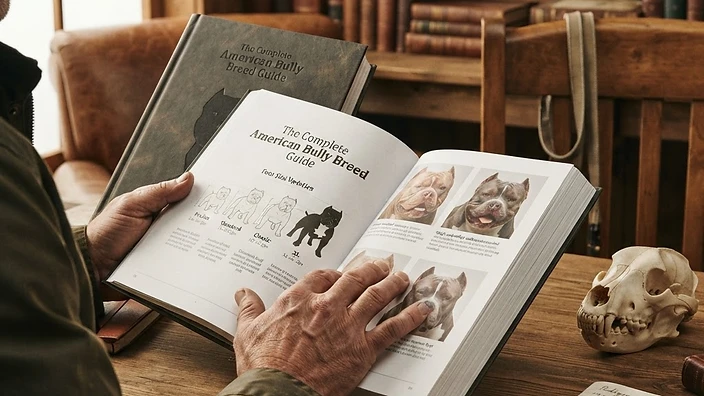
A comparative visual of the four American Bully size varieties recognized by the ABKC — Pocket, Standard, Classic, and XL — illustrating the differences in withers height, chest depth, and muscular development that distinguish each category under the official conformation standard.
Pocket Bully
The Pocket Bully is the smallest recognized variety. Males measure under 17 inches at the withers (typically 13–16 inches); females measure under 16 inches. Despite the name, Pocket Bullies are not small dogs — they are compact, heavily muscled dogs with all the mass and structure of a Standard Bully compressed into a shorter frame. Weight typically ranges from 30 to 60 pounds, though many heavily built individuals exceed this.
Pocket Bullies are enormously popular because they combine maximum visual impact with apartment- and small-home-friendly size. Their shorter stature does, however, mean buyers should pay close attention to structural soundness — compressed builds can amplify orthopedic risks if breeding is not done carefully.
Standard Bully
The Standard Bully is the breed's benchmark variety. Males measure 17 to 20 inches at the withers; females measure 16 to 19 inches. This is the variety most closely aligned with the breed's original vision — a balanced, medium-sized dog with pronounced musculature, a broad chest, and a heavy, blocky head. Weight typically ranges from 65 to 85 pounds for males.
The Standard is the most versatile size for most families, offering an ideal balance of presence, athleticism, and manageability.
Classic Bully
The Classic Bully shares the same height parameters as the Standard but carries a lighter body frame with less overall bulk, a narrower chest, and a build that more closely echoes the American Pit Bull Terrier. The Classic was formally recognized to honor breeders who valued the Bully's functional athleticism alongside its visual appeal. Weight typically ranges from 50 to 70 pounds.
Classic Bullies are often praised for their agility, longevity, and slightly lower risk of the structural challenges that can accompany extreme mass.
XL Bully
The XL Bully is the largest recognized variety. Males measure over 20 inches at the withers; females measure over 19 inches. These are substantial animals — males commonly weigh 80 to 130+ pounds — yet they retain the breed's characteristic gentle temperament. XL Bullies require experienced owners who can manage their size during training and understand the increased nutritional and veterinary costs that accompany a larger dog.
For an in-depth comparison to help you choose between varieties, read our dedicated article on Pocket vs Standard Bully: Which Size Is Right for You?.
Quick Comparison Table
| Variety | Male Height | Female Height | Typical Male Weight | |---|---|---|---| | Pocket | Under 17" | Under 16" | 30–60 lbs | | Standard | 17–20" | 16–19" | 65–85 lbs | | Classic | 17–20" | 16–19" | 50–70 lbs | | XL | Over 20" | Over 19" | 80–130+ lbs |
ABKC Conformation Standard: What Judges Look For
The ABKC conformation standard is the definitive blueprint for the ideal American Bully. Understanding it helps buyers evaluate structural quality and distinguish well-bred dogs from poorly conformed ones.
Head: Large, broad skull with a defined stop. Cheek muscles should be pronounced. The muzzle is broad and blocky, medium in length, with a slightly undershot or level bite acceptable. Lips are semi-close and even. Eyes are round to oval, low set, and may be any color except albinism.
Neck and Body: The neck should be heavy, slightly arched, tapering from shoulder to head, with no excessive dewlap. The back is short, strong, and firm. The chest is broad, deep, and well-sprung — this breadth is a hallmark of the breed. The topline should be level or have a very slight sloping from withers to rump.
Forequarters and Hindquarters: Shoulders are strong and muscular with wide, sloping shoulder blades. Forelegs are straight, strong-boned, and set wide apart. Hindquarters are well-muscled with broad, well-developed thighs. Rear angulation should be moderate — not extreme.
Coat: Short, close, stiff to the touch, and glossy. A natural sheen is desirable.
Gait: The American Bully should move with a confident, powerful stride — not waddling or shuffling. Soundness of movement is a critical evaluation point.
Disqualifications include: albinism, merle coloration (in some ABKC show classes), viciousness or extreme shyness, and height outside the acceptable range for the declared variety.
American Bully Temperament: The Gentle Giant Myth-Buster
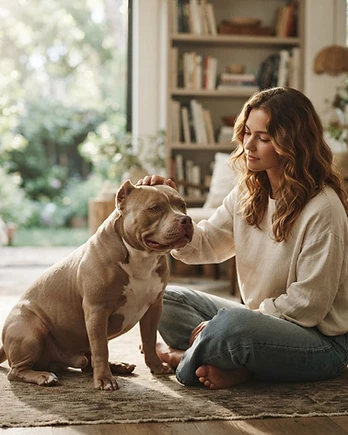
Perhaps no aspect of the American Bully is more misunderstood than its temperament. The breed's muscular, intimidating appearance leads many people to assume aggression — a misconception that couldn't be further from reality.
The American Bully was selectively bred for human sociability above all else. The ABKC standard explicitly describes the ideal temperament as "gentle, friendly, and outgoing." Well-bred American Bullies are:
- Exceptionally affectionate with family members, including children
- Playful and energetic, with a puppy-like enthusiasm that persists well into adulthood
- Eager to please, making them highly trainable with positive reinforcement methods
- Tolerant of handling, including by strangers, when properly socialized
- Confident but not aggressive — a stable American Bully should be curious and friendly, not reactive
Dog-dog sociability varies by individual and bloodline. While many American Bullies coexist beautifully with other dogs, some carry terrier-heritage selectivity and benefit from careful introductions and ongoing socialization.
For a full breakdown of the breed's family suitability — including interactions with children, other pets, and strangers — read Are American Bullies Good Family Dogs? Absolutely. Here's Why.


A tri-color American Bully puppy displaying the characteristic tan point markings produced by the at/at genotype at the Agouti locus, overlaid on a dilute base coat. This image illustrates the rich color genetics possible in well-bred American Bully litters from health-tested parents.
American Bully Coat Colors and Color Genetics
The American Bully comes in one of the most diverse color palettes of any breed — a direct result of the rich genetic backgrounds of its founding breeds and the intentional selection by breeders.
Base Colors
Base coat color in the American Bully is controlled primarily by the MC1R (Extension) locus and the ASIP (Agouti) locus:
- Black — dominant eumelanin expression
- Blue — dilute black, produced by the MLPH (dilution) gene (dd genotype)
- Chocolate (Liver) — brown eumelanin, produced by the TYRP1 (B locus) (bb genotype)
- Lilac — double dilute (chocolate + blue dilution; bbdd genotype), producing a silvery-lavender coat
- Red / Fawn / Buckskin — phaeomelanin-dominant expressions
- Brindle — striped overlay pattern controlled by the K locus
Pattern Modifiers
- Tri-color — produced by the at/at genotype at the Agouti locus, creating tan point markings over a base color. Our Atlas — Lilac Tri-Color Male American Bully puppy, Ella — Lilac Tri Female American Bully puppy, Bowie — Blue Tri Male American Bully puppy, and Diesel — Chocolate Tri Male American Bully puppy are beautiful examples of this pattern.
- Merle — produced by the PMEL17 (M locus) mutation, creating a mottled or patchy pigmentation pattern. Our Hazel — Merle Female American Bully puppy showcases this striking pattern beautifully.
- Piebald (Pied) — white spotting controlled by the S locus
- Ghost tan / Ghost tri — faint or minimally expressed tan points
A Note on Merle
Merle is a controversial color in the American Bully community. The ABKC has historically excluded merle from conformation competition, though many registries accept merle-patterned dogs for registration. Responsible breeders never produce double merle (MM) pairings, which carry a high risk of blindness, deafness, and other serious health deficits.
Influential American Bully Bloodlines
Bloodlines are the language of serious Bully breeders — they communicate structural tendencies, temperament profiles, and health histories. Knowing the major bloodlines helps buyers ask better questions and evaluate pedigrees.
Razor's Edge
Developed by Dave Wilson in the late 1980s and early 1990s, Razor's Edge is arguably the most foundational bloodline in the breed. These dogs introduced the broad head, heavy bone, and shorter muzzle that define the modern American Bully. Many of today's top producers trace directly back to Razor's Edge genetics.
Gottiline
Introduced through The Notorious Juan Gotti, a dog bred by Richard Barajas, the Gottiline amplified extreme mass, a broader, shorter head, and the compact muscular body that Pocket and Standard Bully enthusiasts prize. Gotti bloodlines are extraordinarily influential in high-end show lines.
Remyline
Bred by Fabian Cardoza, the Remyline emphasized a refined head, exceptional temperament, and sound structure. Remyline dogs are known for their consistency and are frequently found in pedigrees that prioritize health alongside aesthetics.
Mikeland
A West Coast-based bloodline known for producing dogs with excellent rear end development, powerful hindquarters, and extreme musculature. Frequently crosses well with Gottiline and Razor's Edge.
Kurupt Bloodline
A more recent but highly influential bloodline known for producing exotic-colored dogs — particularly the lilac, champagne, and ghost tri patterns that now dominate the market.
Other Notable Bloodlines
- Watchdog Bullies — known for XL production
- Iron Cross — valued for longevity and structural soundness
- Bullycamp — known for extreme mass in compact packages
Registration Bodies: ABKC and UKC
Understanding registration matters because it affects breeding rights, show eligibility, and the credibility of a breeder's program.
American Bully Kennel Club (ABKC)
Founded in 2004, the ABKC is the premier registry specifically designed for the American Bully. It maintains the official breed standard, sanctions conformation shows, and issues pedigree documentation. ABKC registration requires both parents to be registered, and show dogs must meet the conformation standard for their declared variety. The ABKC also recognizes Exotic and Micro Bullies — unofficial terms for extreme compact dogs — though these remain controversial and are not part of the four standard varieties.
United Kennel Club (UKC)
The UKC recognized the American Bully as an official breed in 2013. UKC registration opens access to UKC conformation shows and performance events. The UKC standard is broadly similar to the ABKC standard but places a slightly greater emphasis on athleticism and functional structure. Dual registration (ABKC + UKC) is common among serious breeders and adds credibility and market value.
OFA (Orthopedic Foundation for Animals)
While not a breed registry, the OFA is critical to ethical breeding. The OFA maintains health databases for hip dysplasia (via PennHIP and OFA hip evaluation), elbow dysplasia, cardiac evaluations, and eye certifications. Responsible American Bully breeders conduct OFA testing and publish results publicly. Always ask for OFA clearances when evaluating a breeder.
For a complete breakdown of what registration means for buyers, see our dedicated guide on ABKC vs UKC Registration: What Every Bully Owner Must Know.
American Bully vs. Related Breeds
A persistent source of confusion involves distinguishing the American Bully from visually similar breeds. Here's a clear comparison:
| Feature | American Bully | American Pit Bull Terrier | American Staffordshire Terrier | American Bulldog | |---|---|---|---|---| | Primary Purpose | Companion | Working/Sport | Show/Companion | Working/Guard | | Build | Extreme muscle, heavy bone | Athletic, lean | Moderate muscle | Large, powerful | | Head | Very broad, blocky | Moderate, wedge-shaped | Broad, rounded | Large, square | | Temperament | Gentle, calm | Energetic, tenacious | Loyal, confident | Independent, protective | | Average Weight (male) | 65–130+ lbs | 35–65 lbs | 55–70 lbs | 75–120 lbs | | ABKC Registered | Yes | No | No | No |
The American Bully is not a Pit Bull — the ABKC and UKC both classify it as a distinct breed. This distinction matters legally in many jurisdictions where breed-specific legislation (BSL) targets "Pit Bull-type" dogs.
Health Considerations for the American Bully
Like all breeds, the American Bully has specific health predispositions that responsible owners and breeders must understand.
Hip Dysplasia: The broad, muscular build that defines the Bully places significant load on the hips. OFA hip evaluations should be standard in any ethical breeding program. Look for OFA Fair or better certifications in both parents.
Brachycephalic Features: Some Bullies — particularly heavily built Pockets and Exotics — display brachycephalic traits including a shortened muzzle, narrow nares, and elongated soft palate. In moderate cases this causes snoring; in severe cases it may require Brachycephalic Obstructive Airway Syndrome (BOAS) surgery.
Elbow Dysplasia: Common in heavy, rapidly growing breeds. OFA elbow certifications are equally important as hip evaluations.
Cardiac Evaluation: Congenital heart defects occur in the breed. Annual cardiac evaluations by a board-certified cardiologist are recommended for breeding dogs.
Skin Conditions: The American Bully's short, dense coat can be prone to folliculitis, demodex mange, and environmental allergies. Regular grooming and a high-quality, protein-rich diet support skin health.
Life Expectancy: A healthy, well-bred American Bully typically lives 10 to 13 years. Larger varieties (XL) may trend toward the lower end of this range.
For comprehensive health guidance, see The Complete American Bully Health Guide and our full The Complete American Bully Care Guide: Puppyhood to Senior Years.
How Much Does an American Bully Cost?
American Bully pricing is one of the most common questions prospective buyers ask — and one of the most misunderstood areas of the market. Prices vary dramatically based on variety, color, bloodline, registration status, and the breeder's investment in health testing.
- Pet-quality Pocket/Standard Bullies from reputable breeders: $2,500–$5,000
- Show-quality or rare-colored dogs: $5,000–$15,000+
- Top-tier bloodlines (Gotti, Remyline, Razor's Edge descendants): $10,000–$50,000+
- Merle and exotic tri combinations: frequently $8,000–$20,000+
Be cautious of prices that seem too good — they often indicate a lack of health testing, poor conformation, or unregistered dogs. For a full breakdown of what drives pricing and what to expect, read our American Bully Price Guide 2026: What to Expect & Why It's Worth It.
Key Takeaways
- The American Bully was developed in the 1980s–90s from APBT and AmStaff foundation stock, with the goal of creating a calmer, more family-friendly companion with amplified muscular structure.
- The breed is divided into four ABKC-recognized varieties: Pocket, Standard, Classic, and XL — each with distinct height and weight parameters.
- Temperament is the breed's greatest strength: well-bred American Bullies are gentle, affectionate, and highly trainable.
- Coat color genetics in the American Bully are among the most diverse of any breed — tri-color, merle, lilac, blue, and chocolate are all possible and driven by well-understood genetic loci.
- Major bloodlines — Razor's Edge, Gottiline, Remyline, Mikeland — profoundly shape structure, temperament, and market value.
- Both the ABKC and UKC register the breed; dual registration is common and adds credibility.
- OFA health testing (hips, elbows, cardiac, eyes) is non-negotiable for ethical breeding programs.
- The American Bully is a distinct breed — not a Pit Bull — and should be evaluated on its own standard.
Frequently Asked Questions
Is the American Bully the same as a Pit Bull?
No — the American Bully is a distinct breed, officially recognized by both the ABKC and the UKC as separate from the American Pit Bull Terrier. While the two breeds share some ancestry, the American Bully was selectively developed to reduce the working drive of the APBT and amplify a blocky, muscular build and calm temperament. Legally and physically, they are different dogs. This distinction matters in cities with breed-specific legislation, so always verify local ordinances.
Are American Bullies good with children?
American Bullies are widely regarded as one of the best family dogs available. Their gentle, tolerant nature, combined with a playful energy and desire for human affection, makes them exceptional with children of all ages. As with any large, muscular breed, supervision during play with very young children is sensible — not because of aggression, but because of sheer size and enthusiasm. Early socialization and basic obedience training help ensure the best outcomes.
What is the difference between a Pocket Bully and an XL Bully?
The key difference is height — Pocket Bullies stand under 17 inches at the withers (males), while XL Bullies stand over 20 inches. This translates to a significant difference in overall size and weight: a Pocket Bully may weigh 40–55 lbs while a well-built XL can exceed 120 lbs. Both varieties share the same fundamental breed traits — broad head, heavy muscle, gentle temperament — but the XL requires more space, more food, and more physical management during training. See our full Pocket vs Standard Bully comparison guide for a detailed breakdown.
What health tests should a reputable American Bully breeder perform?
At minimum, ethical breeders should conduct OFA hip and elbow evaluations, a cardiac evaluation by a board-certified cardiologist, and an OFA CAER (ophthalmologist) eye exam on all breeding dogs. DNA testing for known heritable conditions, including degenerative myelopathy (DM) screening, is increasingly standard. All results should be publicly accessible through the OFA database. Buyers should request documentation and verify results independently before committing to a purchase.
How long do American Bullies live?
A healthy, well-bred American Bully typically lives between 10 and 13 years. Smaller varieties (Pocket, Classic) tend toward the higher end of this range, while XL Bullies may average slightly shorter lifespans — consistent with the general pattern seen in larger dog breeds. Proper nutrition, regular veterinary care, appropriate exercise, and a stress-free home environment are the strongest predictors of longevity. For guidance on lifelong care, see The Complete American Bully Care Guide: Puppyhood to Senior Years.
What should I look for in an American Bully breeder?
A reputable breeder will be registered with the ABKC and/or UKC, conduct and publish OFA health tests on all breeding dogs, raise puppies in a home environment with early socialization, provide a health guarantee, and welcome questions about pedigree, bloodlines, and breeding philosophy. Red flags include no health testing, refusal to provide references, dogs not registered with a recognized registry, and pressure to buy quickly. Browse our about our breeding program page to learn how we approach each of these standards.
Ready to Bring an American Bully Into Your Life?
If this guide has deepened your appreciation for this extraordinary breed, the next step is finding the right puppy for your family. At American Bully Haven Pups, every litter we produce reflects years of careful pedigree research, rigorous health testing, and a genuine love for this breed.
Explore our available American Bully puppies — including stunning tri-color, merle, and exotic-colored individuals — or visit our adoption guide to understand our process. If you're a first-time buyer, our The First-Time American Bully Owner's Complete Guide will walk you through everything from puppy-proofing your home to the first vet visit.
Have questions? We'd love to talk. Contact us anytime — we believe that finding the right match between family and puppy is the most important part of what we do.
Explore our full resource library for more in-depth guides on nutrition, health, training, and everything else you need to raise an exceptional American Bully.