Bringing an American Bully into your home is one of the most rewarding decisions you'll ever make. These dogs — with their unmistakable broad chests, kind eyes, and deeply loyal temperaments — aren't just pets. They become the emotional center of a household, the dog that greets every guest like a long-lost friend and leans into you after a hard day with quiet, steadfast devotion. But like any relationship worth having, the bond between an American Bully and their owner is built through consistent, informed care.
This guide is designed to be the only American Bully care resource you'll ever need. Whether you're welcoming a new puppy or navigating the slower pace of your dog's senior years, every section below is grounded in veterinary best practices, ABKC and UKC breed standards, and the hands-on experience of raising structurally correct, health-tested American Bullies here at American Bully Haven Pups in Austin, Texas. We've organized everything in the order of a dog's life — because great care isn't a single moment, it's a lifelong commitment.
If you're just beginning your research, we recommend also exploring The Complete American Bully Breed Guide: Everything to Know for foundational breed context, and browsing our full resource library for deep dives into every care subtopic covered here.
Key Takeaways
- American Bullies thrive on structured daily routines covering feeding, exercise, mental stimulation, and rest.
- Exercise must be age-appropriate — over-exercising puppies under 12 months can damage developing growth plates.
- Grooming is low-maintenance but consistent care of skin folds, ears, and nails is essential for this breed.
- Brachycephalic-adjacent anatomy in some lines means heat sensitivity is a real safety concern, especially in Texas summers.
- Preventive veterinary care — including OFA hip/elbow evaluations, cardiac screening, and annual bloodwork — is the cornerstone of a long, healthy life.
- A properly socialized American Bully is confident, gentle, and adaptable; early exposure windows (8–16 weeks) are irreplaceable.
- Senior Bullies (7+ years) need adjusted nutrition, joint support, and more frequent vet check-ins.
- Home and yard safety, seasonal adjustments, and travel prep all contribute meaningfully to your Bully's quality of life.
The American Bully at a Glance: Breed-Specific Care Considerations
Before diving into daily routines, it helps to understand what makes the American Bully distinct from other molosser-type breeds. Recognized by the American Bully Kennel Club (ABKC) and the United Kennel Club (UKC), the breed is divided into four size classes: Pocket (under 17" at the withers for males), Standard (17"–20"), Classic, and XL (over 20"). Each class carries slightly different care needs, particularly around exercise volume and caloric requirements.
The American Bully descends primarily from the American Pit Bull Terrier and American Staffordshire Terrier, with selective influence from the American Bulldog, English Bulldog, and Olde English Bulldogge in some lines. This heritage gives the breed its hallmark muscular build, but also introduces some predispositions worth knowing:
- Brachycephalic tendencies in heavier-boned lines — particularly XL and some Classic Bullies — can affect thermoregulation and exercise tolerance.
- Hip and elbow dysplasia are the most commonly screened orthopedic conditions; OFA (Orthopedic Foundation for Animals) evaluations are the industry standard.
- Skin fold dermatitis is a concern in dogs with pronounced facial or body folds; routine fold hygiene prevents yeast and bacterial overgrowth.
- Cardiac conditions, including aortic stenosis, can appear in the breed; cardiac clearance via board-certified cardiologist is recommended before 24 months.
- Hypothyroidism and allergic skin disease (environmental and food-triggered atopic dermatitis) appear at meaningful rates in the breed.
Understanding these predispositions isn't cause for alarm — it's the foundation of proactive care. For a deeper look at breed structure and temperament, see The Complete American Bully Breed Guide: Everything to Know.
Puppyhood Care (8 Weeks – 6 Months)
The First 72 Hours at Home
The transition from breeder to home is one of the highest-stress periods in a puppy's life. Keep the first 72 hours calm and structured. Designate a single safe space — a crate or x-pen in a low-traffic area — where the puppy can decompress. Introduce family members one at a time. Avoid large gatherings, loud music, or overwhelming stimulation during the adjustment window.
Feed the same food your breeder sent home for the first two weeks. A sudden diet change combined with environmental stress is a reliable recipe for gastrointestinal upset. If you plan to transition foods, do so gradually over 10–14 days using a 25/50/75/100% ratio.
Vaccination and Parasite Prevention Schedule
Puppies should arrive with at least their first DHPP (Distemper, Hepatitis, Parvovirus, Parainfluenza) combination vaccine, typically administered at 6–8 weeks. Your veterinarian will booster this at 10–12 weeks and again at 14–16 weeks. Rabies vaccine is given at 12–16 weeks depending on local ordinance. Bordetella (kennel cough) is recommended for any puppy with socialization class or daycare exposure.
Flea, tick, and heartworm prevention should begin by 8 weeks. In Austin's warm climate, year-round heartworm prophylaxis (ivermectin- or milbemycin-based monthly chewables) is non-negotiable. Intestinal parasite screening via fecal float at 8 and 12 weeks is standard of care.
Early Socialization: The Critical Window
The socialization window — roughly 3 to 16 weeks of age — is the most neurologically plastic period of a dog's life. Experiences (positive ones) during this window create lasting behavioral templates. For American Bullies, who are naturally confident but can develop selective reactivity without proper exposure, this window is irreplaceable.
Target at least 100 novel experiences by 16 weeks: different surfaces (grass, gravel, tile, metal grates), sounds (traffic, children, thunderstorms via recordings), people (hats, uniforms, beards, strollers), and animals. Pair every exposure with high-value treats. Puppy kindergarten classes — once vaccination series is underway — provide structured socialization in a safe environment.
Puppy Exercise: Less Is More
One of the most common mistakes new Bully owners make is over-exercising their puppy. The growth plates in an American Bully's long bones don't close until approximately 12–18 months. High-impact repetitive exercise before closure — running on hard surfaces, forced fetch, jumping — can cause microfractures and contribute to lifelong orthopedic problems.
The guideline most veterinary orthopedic specialists endorse: 5 minutes of structured exercise per month of age, twice daily. A 12-week-old puppy needs only 15 minutes of leash walking twice a day. Free play in a safe yard is gentler on joints and generally fine in moderation.

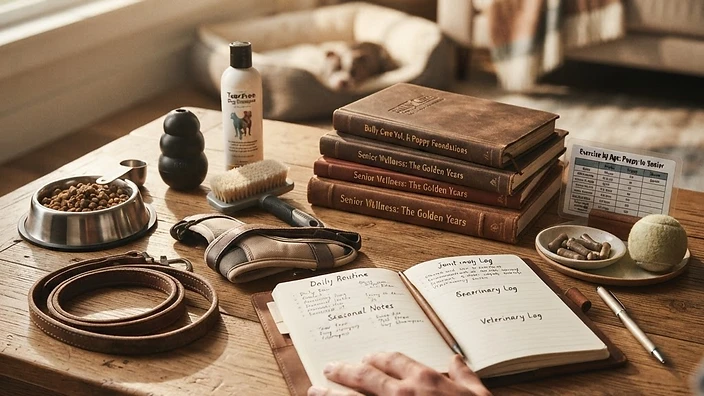
A young American Bully puppy rests in a comfortable crate setup, illustrating proper early home environment and settling techniques.
Adolescent Care (6 Months – 18 Months)
Nutrition for a Growing Bully
Adolescent American Bullies are caloric furnaces. A Standard male at 9 months may require 2,200–2,800 kcal/day depending on activity level and individual metabolism. Feed a large-breed puppy formula or an all-life-stages food with AAFCO (Association of American Feed Control Officials) nutritional adequacy for growth. Look for:
- Crude protein: 24–30% on a dry matter basis
- Fat: 12–18%
- Calcium-to-phosphorus ratio: 1.2:1 to 1.4:1 (critical for bone development)
- DHA (docosahexaenoic acid) from fish oil for brain and joint development
Avoid excessive calcium supplementation — it disrupts the calcium-phosphorus ratio and can paradoxically contribute to developmental orthopedic disease in large-breed puppies.
Training and Mental Stimulation
American Bullies are intelligent, people-oriented dogs that respond exceptionally well to positive reinforcement-based training. By 6 months, your Bully should be solid on sit, down, stay, come, and leash manners. Begin introducing impulse control exercises: