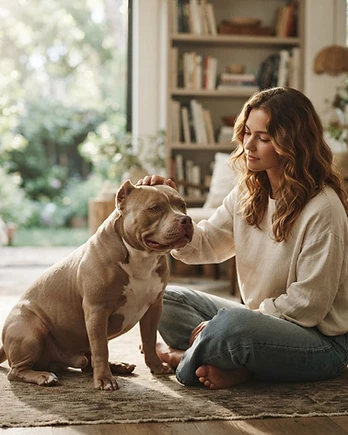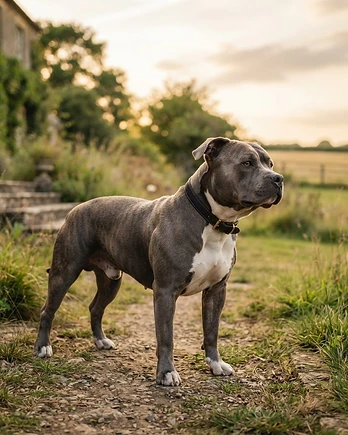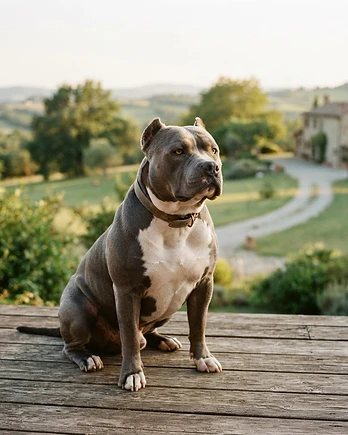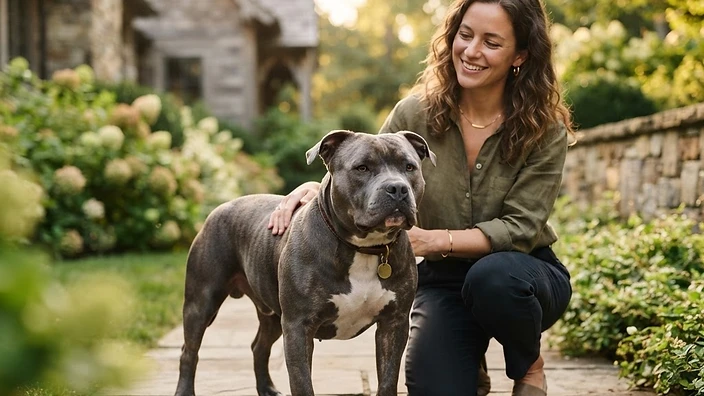
Few breeds in the modern canine world have inspired as much passion, misunderstanding, and devoted loyalty as the American Bully. From its humble origins in backyards across the American South and East Coast to its rise as one of the most recognizable and beloved companion breeds on the planet, the American Bully is a living testament to what intentional, ethical breeding can achieve. Bold in structure, gentle in spirit, and endlessly loyal in heart — this is a breed that defies every stereotype thrown at it.
At American Bully Haven Pups in Austin, Texas, we have spent years immersed in this breed — studying bloodlines, health-testing our dogs through OFA protocols, mentoring new owners, and producing puppies that exemplify the breed standard in both body and temperament. We wrote this guide because we believe every prospective owner deserves a single, trustworthy, comprehensive resource. Whether you're researching your very first Bully or you're a seasoned enthusiast diving deeper into conformation and genetics, you'll find everything you need right here.
This is the most thorough American Bully breed guide we know of. Bookmark it, share it, and return to it often. And when you're ready to take the next step, our available American Bully puppies are waiting to meet you.
Origin and History of the American Bully
The American Bully emerged in the United States during the late 1980s and early 1990s, primarily developed by breeders in Virginia and Los Angeles who sought to create the ultimate companion dog — powerful and impressive in appearance, yet docile, affectionate, and family-safe in temperament.
The breed's foundation rests on the American Pit Bull Terrier (APBT) and the American Staffordshire Terrier (AmStaff), both of which contributed athleticism, drive, and structural integrity. To expand body mass, broaden the chest, and reduce prey drive, breeders selectively introduced genetics from the English Bulldog, Olde English Bulldogge, and in some lines, the Staffordshire Bull Terrier and American Bulldog. The result was not a Pit Bull with a different name — it was a genuinely distinct phenotype with a purpose-built temperament.
By the early 2000s, the breed had developed enough consistency to warrant formal recognition. The American Bully Kennel Club (ABKC) was founded in 2004 by Dave Wilson and Carlos Barksdale, establishing the first official breed standard and registry. The United Kennel Club (UKC) followed with formal recognition in 2013, cementing the American Bully's status as a legitimate, distinct breed — not a variant of the APBT.
Key Founding Kennels and the Breed's Roots
Several pioneering kennels shaped the early American Bully gene pool:
- Razor's Edge Kennels (Dave Wilson, Virginia) — widely credited as a foundational influence, producing the compact, heavily muscled dogs that defined the early Standard and Classic varieties.
- Gottiline (Richard Barajas, California) — responsible for the iconic Notorious Juan Gotty, arguably the most influential sire in American Bully history, whose descendants appear in pedigrees worldwide.
- Remyline Kennels — known for producing dogs with exceptional head structure, wide chests, and calm temperaments.
- Greyline and Mikeland Kennels also contributed significantly to early bloodline diversity.
Understanding this history matters because pedigree literacy — knowing what bloodlines run behind a dog — is one of the most important skills an ethical breeder and informed buyer can develop. At American Bully Haven Pups, our breeding program is built on documented, health-tested lineages with traceable ABKC registration.
The Four Official Size Varieties
One of the most common points of confusion among newcomers is the size classification system. The ABKC recognizes four distinct varieties, each judged separately at conformation events. These are not separate breeds — they are the same breed in different size expressions.

A visual comparison of the four official American Bully size varieties recognized by the ABKC — Pocket, Standard, Classic, and XL — illustrating differences in height, bone density, and body mass while demonstrating the consistent breed type across all four classes.
Pocket Bully
The Pocket Bully is the smallest variety and among the most popular. Despite the name, these are not toy dogs — they are compact, heavily muscled, and structurally impressive.
- Height: Males 14–17 inches at the withers; Females 13–16 inches
- Weight: Typically 11–22 kg (25–50 lbs), though weight is not the primary criterion
- Appearance: Extremely broad chest relative to height, pronounced head structure, short back, thick bone
- Temperament: Characteristically gentle and manageable; excellent for apartment or urban living
Pocket Bullies are produced by selectively breeding smaller individuals within Standard lines, not by crossing with Chihuahuas or other small breeds — a common misconception we address in our FAQ below.
Standard American Bully
The Standard is the benchmark variety from which all others are measured. It best represents the breed's original vision: a medium-sized, heavily muscled companion with a broad, blocky head and a confident, stable temperament.
- Height: Males 17–20 inches; Females 16–19 inches
- Build: Deep chest, wide shoulders, thick neck, well-sprung ribs, strong topline
- Weight: Typically 30–65 lbs depending on height and bone density
Classic American Bully
The Classic shares the same height range as the Standard but carries a lighter body frame with less overall muscle mass and a less exaggerated build. It most closely resembles the APBT in body type, with the Bully's characteristic head and temperament.
- Best suited for owners who prefer a leaner, more athletic silhouette
- Often slightly more agile and easier to keep at a healthy weight
- Holds the same ABKC temperament standard as all other varieties
XL American Bully
The XL Bully is the largest variety, commanding attention in any room. These dogs retain the breed's gentle nature despite their imposing size.
- Height: Males over 20 inches (up to approximately 23 inches); Females over 19 inches
- Weight: Males commonly 80–150 lbs; Females 70–120 lbs
- Note: The XL was subject to Breed Specific Legislation (BSL) in the United Kingdom beginning in 2023, making it a politically significant variety in international discussions
Size Variety Comparison Table
| Variety | Male Height | Female Height | Relative Build | |---|---|---|---| | Pocket | 14–17 in | 13–16 in | Compact, very heavy bone | | Standard | 17–20 in | 16–19 in | Moderate height, maximum muscle | | Classic | 17–20 in | 16–19 in | Standard height, lighter frame | | XL | 20–23 in | 19–22 in | Largest, still balanced |
ABKC Conformation Standard: What Judges Look For
The American Bully Kennel Club (ABKC) conformation standard is the official benchmark for evaluating breed quality. Understanding it helps buyers distinguish between well-bred, standard-compliant dogs and those produced without regard for structural correctness.
Head and Facial Structure
- Head: Large, broad skull with pronounced cheek muscles (masseter development), deep stop, and a well-defined forehead
- Muzzle: Medium length, broad and deep; scissors bite or level bite preferred
- Eyes: Round to oval, set wide apart; all colors accepted except albinism; no wall eye (unpigmented iris) disqualification
- Ears: May be natural or cropped; rose, semi-prick, or prick ears in natural state
Body and Structure
- Neck: Heavy, muscular, slightly arched, tapering from shoulders to head
- Chest: Deep, broad, well-sprung ribs; chest width should not exceed proper movement
- Topline: Level to slightly sloping from withers to croup
- Tail: Low-set, tapering to a fine point; carried low or in a pump handle — never docked in ABKC competition
Movement and Gait
- The ABKC standard calls for confident, powerful, agile movement with good reach and drive
- Single-tracking at speed is acceptable; waddling or rolling gait is a structural fault
- Proper angulation of shoulders (45 degrees) and rear assembly is critical for sound movement
Disqualifications Under ABKC Standard
- Unilateral or bilateral cryptorchidism in males
- Viciousness toward humans
- Albinism
- Dogs over or under height for their entered variety
For full breed standard documentation and upcoming conformation events, visit the official ABKC website. To learn more about how our dogs measure up, explore our breeding program.
American Bully Temperament: The Truth About This Breed
If there is one thing we want every reader to carry away from this guide, it is this: the American Bully was purpose-bred to be a companion dog, and its temperament reflects that intention at a genetic level.
The ABKC standard explicitly states that the American Bully should be "gentle and loving toward people" and that any dog exhibiting "viciousness, unwarranted aggression, or an unsteady temperament" should be disqualified from competition. This is not aspirational language — it is a hard standard enforced at shows.
Core Temperament Traits
- Human-affectionate: Bullies are famously devoted to their families, including children. They are often described as "velcro dogs" that want to be near their people at all times.
- Confident without aggression: A well-bred Bully is stable, self-assured, and non-reactive — not skittish or overly dominant.
- Playful and energetic: Despite a heavily muscled build, Bullies maintain a puppy-like enthusiasm well into adulthood.
- Trainable: High food motivation and desire to please make them responsive to positive reinforcement training.
- Tolerant: Proper socialization produces dogs with excellent tolerance of children, other pets, and novel environments.
Dog-to-Dog Socialization
While American Bullies are not inherently dog-aggressive, same-sex dog aggression can occur, particularly in intact males. Early, consistent socialization beginning before 16 weeks of age dramatically reduces this risk. We provide detailed socialization guidance in The Complete American Bully Care Guide: Puppyhood to Senior Years.
Coat Colors and Color Genetics
The American Bully's coat color diversity is one of its most visually striking features — and one of the most misunderstood from a genetics standpoint. The ABKC accepts all coat colors and patterns with the exception of merle-to-merle breeding (due to associated health risks in double merle offspring).

A collection of American Bully puppies displaying a range of exotic coat colors and patterns including lilac tri-color, chocolate tri, blue tri, and merle, all produced through verified DNA panel-tested breeding pairs at American Bully Haven Pups in Austin, Texas.
Standard Colors
- Black, white, fawn, red, blue (dilute black) — the classic, most common expressions
- Brindle — dark striping over a base coat; can occur over any base color
- Seal — appears black but reflects a brown/red tint in direct sunlight
Exotic and High-Demand Colors
Over the past decade, advances in color genetics testing have made exotic color production more predictable and widespread:
- Chocolate (bb) — produced by two copies of the recessive b allele at the TYRP1 locus, diluting black pigment to brown. Our Diesel — Chocolate Tri Male is a stunning example.
- Blue (dd) — produced by two copies of the recessive d allele (MLPH gene), diluting black to a steel-blue/grey. Meet Bowie — Blue Tri Male for a beautiful example of this color.
- Lilac — a double dilute (bb + dd), combining chocolate and blue dilution genes to produce a pale silvery-lavender coat with light amber or green eyes. See Atlas — Lilac Tri-Color Male and Ella — Lilac Tri Female.
- Tri-color — the tan point pattern (atat genotype at the ASIP locus), adding tan/copper points above the eyes, on the chest, and on the legs over any base color. This is not a separate color but a pattern modifier.
- Merle — produced by the M locus (PMEL gene), creating a mottled, marbled pigmentation effect. Our Hazel — Merle Female showcases this striking pattern. Important: merle-to-merle breedings are never ethical — double merle offspring face a significant risk of blindness and deafness.
- Ghost merle (cryptic merle) — a dog carrying a shortened M allele that may not visibly express merle but can still produce merle offspring; DNA panel testing is essential.
Color Pricing Reality
Exotic colors (lilac, lilac tri, merle, ghost tri) command significantly higher prices — often $3,000–$8,000+ — due to the genetic complexity and predictability required to produce them consistently. However, color alone does not equal quality. Structural soundness, health clearances, and temperament always come first.
Influential Bloodlines in the American Bully
Bloodline knowledge separates informed buyers from those making $5,000 decisions blindly. Here are the most historically significant and currently influential bloodlines:
Foundational Bloodlines
- Razor's Edge — groundbreaking in establishing the compact, wide-chested Standard type; heavy bone, calm temperament
- Gottiline — Juan Gotty's offspring reshaped the breed's head type; wide skulls, short muzzles, stocky builds
- Remyline — known for exceptional athleticism combined with extreme structure
- Kurupt Bloodline — highly influential in the XL variety; extreme size with retained proportion
Modern and Exotic-Color Lines
- Miagi Bully and King Fisher lines — prominent in producing consistent lilac and tri expressions
- Niko x Fendi crosses — a popular pairing in the Texas region producing exotic color pups with excellent head type
For a deeper exploration of bloodlines, conformation, and what to look for in a quality pedigree, browse our full resource library.
Registration Bodies: ABKC vs. UKC
Two primary registries govern the American Bully in the United States:
American Bully Kennel Club (ABKC)
- Founded: 2004
- Significance: The founding registry; sets the official breed standard; hosts the largest American Bully-specific conformation events globally
- Registration process: Litter registration, individual registration, and DNA parentage verification available
- Notable: Recognizes all four size varieties as separate show classes
United Kennel Club (UKC)
- Founded: 1898 (American Bully recognized 2013)
- Significance: One of the oldest and most respected all-breed registries in the world; UKC registration adds credibility and opens access to UKC performance events
- Standard: Slightly different from ABKC, emphasizing function alongside form
At American Bully Haven Pups, all our dogs are dual-registered with both ABKC and UKC, providing our buyers with maximum flexibility for showing, breeding programs, and resale value.
Other Registries
- NKC (National Kennel Club) and IOEBA (International Olde English Bulldogge Association) also register American Bullies but carry less industry prestige
- AKC does not recognize the American Bully as a distinct breed — a point of ongoing industry discussion
American Bully vs. Related Breeds: Key Distinctions
Confusion between the American Bully and related breeds is common — and sometimes dangerous when it drives BSL policy. Here is a clear breakdown:
| Feature | American Bully | American Pit Bull Terrier | American Staffordshire Terrier | English Bulldog | |---|---|---|---|---| | Primary purpose | Companion | Working/companion | Show/companion | Companion | | Build | Heavy, wide, short | Athletic, lean-moderate | Moderate, athletic | Stocky, low-slung | | Head | Broad, blocky | Wedge-shaped | Broad, moderate | Extremely wide, wrinkled | | Drive | Low-moderate | High | Moderate | Low | | Registry | ABKC, UKC | UKC, ADBA | AKC, UKC | AKC, UKC | | Prey drive | Lower | Higher | Moderate | Low |
The most important distinction: the American Bully is NOT a Pit Bull. They share ancestry but diverged through selective breeding into genuinely different phenotypes with different temperament profiles. Conflating them in BSL legislation is both scientifically inaccurate and harmful.
Health, Lifespan, and OFA Testing
The American Bully is a generally healthy breed with a lifespan of 10–13 years for Pocket and Standard varieties, and 8–10 years for XL lines due to the additional strain of greater body mass.
Common Health Concerns
- Hip and elbow dysplasia — skeletal conditions common in heavy-boned breeds; OFA hip and elbow evaluations should be performed on all breeding animals
- Brachycephalic Obstructive Airway Syndrome (BOAS) — dogs with extremely shortened muzzles may experience breathing difficulty; responsible breeders select for functional airway anatomy
- Skin conditions — mange (demodectic), allergies, and hot spots are common; regular grooming and appropriate diet reduce risk
- Cardiac conditions — dilated cardiomyopathy (DCM) and aortic stenosis warrant cardiac OFA evaluation in breeding dogs
- Hereditary cataracts and progressive retinal atrophy (PRA) — DNA panel testing available through Embark or Wisdom Panel
Our Health Testing Protocol
Every American Bully Haven Pups breeding dog undergoes:
- OFA hip and elbow radiographic evaluation
- CAER (Canine Eye Registry Foundation) ophthalmologic exam
- OFA cardiac auscultation by a board-certified cardiologist
- Full DNA panel through Embark Veterinary for 200+ genetic health markers and coat color genotyping
For detailed guidance on caring for your Bully from puppyhood through senior years, read The Complete American Bully Care Guide: Puppyhood to Senior Years.
Key Takeaways
- The American Bully is a distinct breed created in the late 1980s–1990s from APBT, AmStaff, and bulldog crosses, formally recognized by ABKC (2004) and UKC (2013)
- Four official varieties exist: Pocket, Standard, Classic, and XL — differentiated by height, not weight
- The breed standard demands human-friendly, stable temperament as a core requirement, not an afterthought
- Coat color genetics are complex and fascinating — exotic colors like lilac, chocolate tri, and merle require DNA panel verification of both parents
- Responsible breeding requires OFA hip/elbow, cardiac, and eye health clearances plus DNA panel testing
- The American Bully is not a Pit Bull — conflating the two breeds is inaccurate and drives unfair breed legislation
- Dual ABKC and UKC registration provides the most value and flexibility for buyers
- Price ranges vary widely: $1,500–$3,500 for standard colors; $3,000–$8,000+ for verified exotic colors from health-tested parents
Frequently Asked Questions
Is the American Bully dangerous or aggressive?
No. The American Bully was selectively bred away from the working drive and dog-aggression historically associated with its terrier ancestors. The ABKC breed standard explicitly disqualifies any dog showing human-directed aggression. Decades of selective breeding for companionship have produced a dog that is statistically among the most human-affectionate of all large breeds. As with any dog, individual temperament is shaped by genetics, early socialization, and owner training — all of which responsible breeders and educated owners can control.
What is the difference between a Pocket Bully and a Standard Bully?
The primary difference is height at the withers. A Pocket Bully male stands between 14–17 inches tall; a Standard male stands 17–20 inches. Both carry the same broad, heavily muscled body type and are judged under the same structural standard — just in different size classes. Weight is not a disqualifying criterion in either class; judges evaluate proportion and structural correctness relative to height. Pocket Bullies are not produced by crossing with small non-Bully breeds.
How much does an American Bully puppy cost?
Pricing varies based on variety, color, pedigree quality, and health testing. Standard and Classic puppies from health-tested, ABKC/UKC-registered parents typically range from $1,500–$3,500. Exotic color puppies (lilac, lilac tri, merle, chocolate tri) from verified parents regularly sell for $3,000–$8,000 or more. Be cautious of puppies priced below $1,000 — they are unlikely to come from health-tested parents with legitimate registration. Review our adoption guide for a full breakdown of what to expect during the purchase process.
Are American Bullies good with children?
American Bullies are consistently ranked among the best family dogs for households with children. Their patient, gentle, and playful temperament — combined with physical sturdiness — makes them ideal companions for active families. That said, no dog of any breed should be left unsupervised with young children. Teaching children to interact respectfully with dogs is as important as training the dog itself. Our puppies are raised with early neurological stimulation (ENS) protocols and exposed to children from the first weeks of life.
What is the lifespan of an American Bully?
Pocket and Standard American Bullies typically live 10–13 years with proper care, nutrition, weight management, and veterinary oversight. XL Bullies, due to the physiological demands of greater body mass, average 8–10 years. Maintaining a lean body condition score (BCS of 4–5 out of 9), providing joint-supportive nutrition, and scheduling annual wellness exams significantly extend healthy lifespan. See The Complete American Bully Care Guide for our full longevity protocol.
Does color affect health in American Bullies?
Most coat colors in the American Bully are cosmetically distinct without inherent health implications. However, two color genetics warrant caution: double merle (MM genotype) — produced when two merle-carrying dogs are bred together — carries a 25% probability of producing puppies with severe visual and auditory deficits. Additionally, color dilution alopecia (CDA) can occur in blue (dd) dogs, causing coat thinning and skin inflammation, though not all blue dogs are affected. Reputable breeders perform DNA panel testing and never breed merle-to-merle.
Additional Resources and Next Steps
The American Bully is a remarkable breed — misunderstood by headlines, celebrated by those who truly know them. Whether you're drawn to the compact power of a Pocket Bully, the classic lines of a Standard, or the eye-catching exotic colors of a lilac tri or merle, you're considering one of the most rewarding companion dogs available today.
We invite you to explore more depth on specific topics through our cluster articles:
- The Complete American Bully Breed Guide: Everything to Know
- The Complete American Bully Breed Guide: Everything You Need to Know
- The Complete American Bully Breed Guide: Everything You Need to Know
When you're ready to bring one of these extraordinary dogs into your life, meet our current litter — including Diesel, Atlas, Bowie, Hazel, and Ella. Each puppy is ABKC/UKC registered, health-tested, socialized from birth, and comes with full documentation and lifetime breeder support.
Have questions? We'd love to hear from you — contact us anytime. This is more than a transaction; it's the beginning of a relationship we take seriously.