Few breeds command a room quite like the American Bully. Broad-chested, low-slung, and radiating confidence, these dogs stop strangers in their tracks — and then immediately dissolve the tension with a wagging tail and a sloppy kiss. If you've ever been loved by an American Bully, you already know: the exterior is all show. Inside is one of the most gentle, people-devoted companions the dog world has ever produced.
At American Bully Haven Pups in Austin, Texas, we've dedicated ourselves to this breed with the full weight of ABKC and UKC registration, health-tested bloodlines, and a breeding philosophy rooted in temperament first, structure second. We wrote this guide because we believe every future owner — and every curious enthusiast — deserves a single, authoritative resource that covers everything. Origin story. Size classes. Conformation standards. Coat color genetics. Influential sires. Registration bodies. Common myths. All of it, right here.
Whether you're comparing a Pocket Bully to an XL, trying to understand what "lilac tri" means genetically, or simply deciding whether this is the right breed for your family, this is the only guide you'll need. Let's dig in.
Origin and History of the American Bully
The American Bully is a deliberately developed breed, not an accidental one. Its roots trace to the early 1980s and 1990s, primarily on the East Coast and West Coast of the United States, when breeders began selectively crossing the American Pit Bull Terrier (APBT) with the American Staffordshire Terrier (AmStaff) as the primary foundation stock. To achieve the breed's signature wide chest, blocky head, and compact musculature, breeders also introduced measured influence from the English Bulldog, Olde English Bulldogge, and in some lines, the Staffordshire Bull Terrier.
The goal was intentional and visionary: strip away the high-prey-drive working-dog edge of the APBT while amplifying its legendary affection for humans, then wrap that temperament in a visually striking, heavily muscled package. The result was a companion breed — not a fighting breed, not a guard dog — purpose-built for family life.
The American Bully Kennel Club (ABKC) was founded in 2004 by Dave Wilson and Carlos Barksdale, giving the breed its first formal registry, written conformation standard, and show circuit. The United Kennel Club (UKC) followed in 2013, granting official breed recognition and further legitimizing the American Bully on the national stage. Today, the breed enjoys a passionate global community, with shows held across North America, Europe, and beyond.
Key distinction: The American Bully is NOT a Pit Bull. It is a separate, independently registered breed. While it shares ancestral DNA with the APBT, decades of selective breeding have produced a distinct phenotype and temperament profile that sets it clearly apart.
The Four ABKC Size Varieties
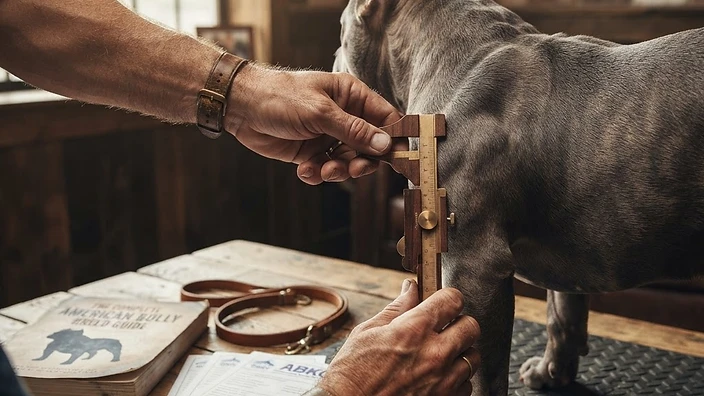
One of the most frequently misunderstood aspects of the American Bully is its size classification system. The ABKC recognizes four official varieties, differentiated primarily by height at the withers — not weight. All four share the same breed standard for structure, head type, and temperament; only scale changes.
Pocket Bully
- Males: 14–17 inches at the withers
- Females: 13–16 inches at the withers
- Despite the name, Pocket Bullies are densely muscled and typically weigh 30–60 lbs
- Maximum visual impact in the smallest frame; highly popular for apartment and urban living
- Genetically, many Pocket lines carry the dwarfism-associated gene variant (chondrodysplasia) — responsible ethical breeders screen for associated health implications
Standard Bully
- Males: 17–20 inches at the withers
- Females: 16–19 inches at the withers
- The "classic" American Bully size; weight typically 65–85 lbs
- Balanced proportions, strong topline, and the full expression of breed type without extreme mass
Classic Bully
- Same height parameters as the Standard
- Lighter body frame, less overall body mass, and a slightly less exaggerated head
- Often described as closer to the APBT ancestor in body structure while retaining the Bully head type
- Popular among owners who want athleticism alongside breed type
XL Bully
- Males: Over 20 inches (20–23 inches typical) at the withers
- Females: Over 19 inches (19–22 inches typical) at the withers
- Weight commonly 80–150 lbs depending on structure
- The largest official ABKC variety; requires the same structural correctness at greater scale
- High demand worldwide; XL lines have produced some of the breed's most influential sires
| Variety | Male Height | Female Height | Typical Weight | |---------|------------|---------------|----------------| | Pocket | 14–17 in | 13–16 in | 30–60 lbs | | Standard | 17–20 in | 16–19 in | 65–85 lbs | | Classic | 17–20 in | 16–19 in | 55–75 lbs | | XL | 20–23 in | 19–22 in | 80–150 lbs |
Note on "Extreme" and "Micro" labels: You'll encounter these terms widely on social media. "Extreme Bully" is not an official ABKC variety — it describes dogs with exaggerated features (wider chest, more pronounced head, shorter muzzle) within the Standard or Pocket class. "Micro Bully" refers to dogs below Pocket height minimums and is not a recognized ABKC variety. At American Bully Haven Pups, we breed to the written standard.
ABKC Conformation Standard: What Judges Look For
Understanding the conformation standard helps you evaluate a breeder's breeding decisions and recognize quality structure. The ABKC standard evaluates the following:
Head and Expression
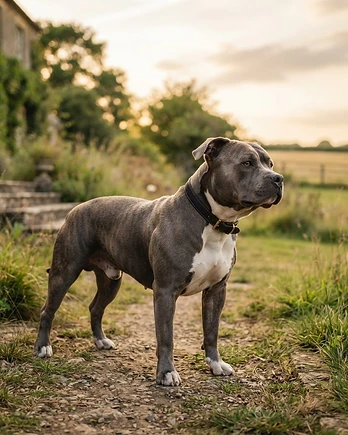
The head should be large and broad, with a wide, deep skull and pronounced cheek muscles. The stop (the indentation between forehead and muzzle) should be well-defined. Muzzle length is medium (30–40% of total head length), with a wide, deep underjaw. Eyes are round to oval, set wide, and come in any color except albinism. Ears can be natural or cropped.
Neck and Topline
Heavy, muscular neck with a slight arch; no dewlap. The topline — the dog's back viewed from the side — should be level or with a very slight rise over the loin. A roached or sagging topline is a fault.
Body and Chest
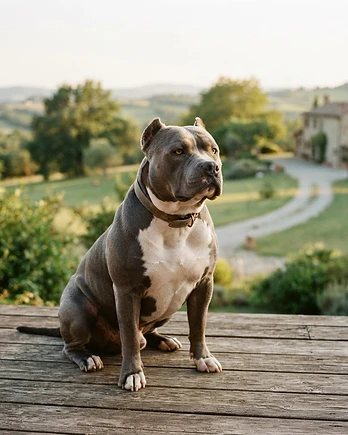
The chest is broad, deep, and full, with well-sprung ribs. The forechest should be visible from the front. Depth of chest should reach the elbow. The body is compact and muscular with a short, broad back.
Forequarters and Hindquarters
Front legs should be straight, strong-boned, and set wide. Pasterns (the equivalent of the human wrist) should be upright. Hindquarters are well-muscled with moderate angulation; hocks should be well let-down and perpendicular to the ground.
Coat and Color
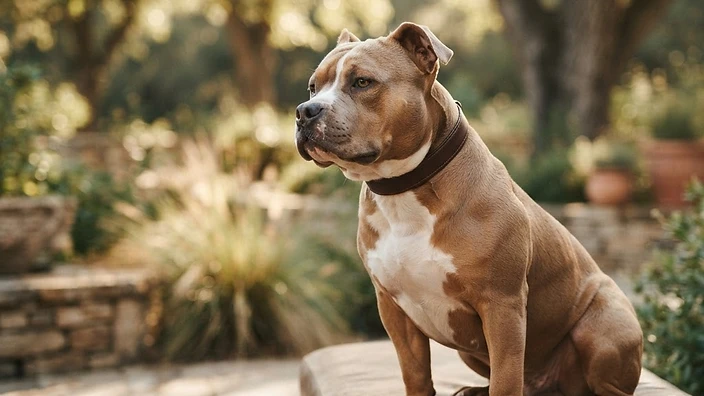
Short, close, stiff, and glossy. All colors and patterns are accepted under the ABKC standard with the exception of merle — which, while genetically present in the breed, was historically a disqualification in some show venues. UKC currently disqualifies merle. Always verify current show rules if you plan to exhibit.
Gait
Smooth, powerful, and effortless. The gait should reflect the dog's structural correctness — a well-built Bully moves with confidence and minimal wasted motion.

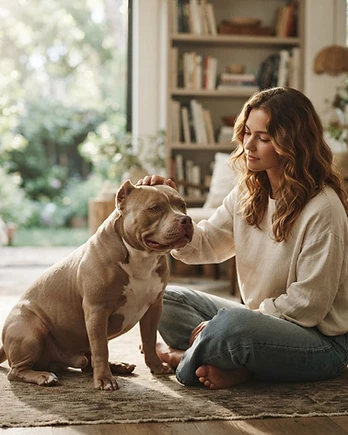
An American Bully sits relaxed alongside children in a home setting, illustrating the breed's hallmark gentleness and deep bond with family members that makes them exceptional companion dogs.
American Bully Temperament: The Breed's Greatest Strength
If structure is what people see, temperament is what people feel — and the American Bully's temperament is the breed's defining achievement. The ABKC breed standard explicitly describes the ideal temperament as: gentle, loving, loyal, stable, and highly trainable. Dogs that display human aggression are disqualified from the show ring and should never be bred.
Family Devotion
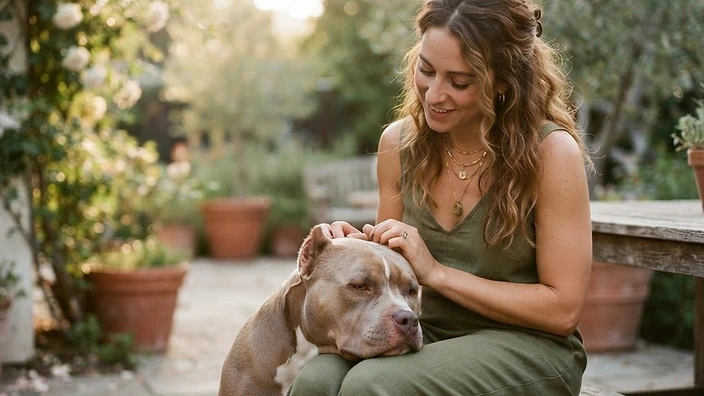
American Bullies are profoundly people-oriented. They bond deeply with every member of the household and are renowned for their patience with children. The nickname "nanny dog" is often applied — with good reason. Their sensitivity to human emotion is extraordinary; many owners describe their Bullies as "velcro dogs" who want constant physical contact.
Socialization Requirements
Despite their gentle nature, early and consistent socialization is essential. Puppies should be exposed to diverse environments, people, sounds, and other animals between 3 and 16 weeks of age — the critical socialization window. Dogs that miss this window may develop anxiety or reactivity as adults, not aggression, but enough stress to reduce quality of life.
Dog-to-Dog Interaction
Some American Bullies, particularly intact males, may exhibit same-sex dog selectivity inherited from APBT ancestry. This is not aggression toward humans and should not be conflated with it. Proper introduction protocols and early socialization with other dogs significantly reduce this tendency.
Trainability
American Bullies are intelligent, eager-to-please dogs that respond exceptionally well to positive reinforcement training. They thrive on routine, consistency, and relationship-based training methods. Many excel in obedience, weight pull, and canine good citizen (CGC) programs.
For a deeper dive into raising and training your American Bully from puppyhood through the senior years, our Complete American Bully Care Guide: Puppyhood to Senior Years is an essential companion resource.
Coat Colors and Color Genetics
The American Bully's color palette is one of the most diverse in the canine world. Understanding the genetics behind these colors helps you make sense of breeder pricing and marketing language — and helps you identify ethical breeders who understand what they're producing.
Base Colors
- Black (dominant black, K locus)
- Blue (dilute black; d allele at the MLPH gene)
- Chocolate/Brown (recessive b allele at the TYRP1 gene)
- Lilac (double dilute: blue + chocolate; dd + bb)
- Red/Fawn (phaeomelanin expression; e allele at MC1R or ay at the A locus)
- Champagne (dilute red/fawn)
- Tuxedo/Black and White
Pattern Modifiers
- Tri-color: Three-color expression (typically base + tan points + white); requires the at allele at the ABKC agouti locus
- Merle: Caused by the SILV gene insertion (M allele); creates mottled, irregular pigment patches. Double merle (MM) produces severe health defects including blindness and deafness — responsible breeders never breed merle to merle
- Brindle: Dark striping over a lighter base; caused by the kbr allele
- Piebald/Parti: White spotting caused by the S locus (sp allele)
- Ghost tan: Faint tan points, often seen in blue or lilac dogs
Premium Color Combinations
Colors like lilac tri, blue tri, chocolate tri, merle, and champagne tri command premium pricing — typically $3,000–$10,000+ — due to the precise genetic stacking required to produce them. This is legitimate when breeders genetically test their dogs; it becomes problematic when breeders prioritize color over health and structure.
Want to see these colors in person? Explore our current litter: Atlas — Lilac Tri-Color Male, Bowie — Blue Tri Male, Diesel — Chocolate Tri Male, Ella — Lilac Tri Female, and Hazel — Merle Female.
Influential Bloodlines in American Bully History
Bloodlines tell the breed's story. These are the sires and kennels that shaped the modern American Bully:
Razor's Edge
Founded by Dave Wilson (also the ABKC co-founder), Razor's Edge is the most influential bloodline in the breed's early history. Razor's Edge dogs set the template for the blocky head, wide chest, and gentle temperament that define the American Bully.
Gottiline
Originating from Richard Barajas's Juan Gotty (whelped 1997), the Gottiline produced shorter, wider, more exaggerated dogs than the Razor's Edge. Juan Gotty sired over 1,000 registered offspring and is arguably the most reproduced sire in American Bully history.
Kurupt Bloodline
Developed in California, Kurupt dogs are known for extreme body mass and wide chests. The Kurupt Farmhouse kennel produced several influential XL and Extreme sires.
Mikeland
A Pacific Northwest line known for correct structure and exceptional temperament. Frequently used as a corrective cross to preserve functional conformation alongside visual impact.
Remyline
Developed by Fabian Hernandez, Remyline produced dogs with elite head structure and a strong influence in the show circuit. The sire Remy Martin remains one of the most recognizable names in the breed.
Monster G / Tri-Color Revolution
In the 2010s, breeders working with Monster G bloodline and related crosses pioneered the explosion of tri-color genetics in the breed, making the lilac tri and blue tri combinations widely available for the first time.

A group of American Bully puppies displaying multiple premium coat color and pattern combinations including lilac tri-color, blue tri, and merle, demonstrating the genetic diversity possible within a single well-bred litter.
Registration Bodies: ABKC vs. UKC
Two primary registries govern the American Bully in the United States, and understanding the difference matters for show participation and pedigree value.
American Bully Kennel Club (ABKC)
- Founded: 2004
- The breed-specific founding registry for the American Bully
- Maintains the official written breed standard
- Operates its own show circuit with judges trained specifically in American Bully conformation
- Registers all four size varieties plus the Micro (in limited contexts)
- Registry for the most serious breeders and competitors
United Kennel Club (UKC)
- Founded: 1898 (general canine registry)
- Recognized the American Bully as a breed in 2013
- Applies its own conformation standard, which differs in some details from the ABKC standard (notably, UKC currently disqualifies merle)
- UKC registration opens access to UKC performance events, including obedience and rally trials
- Many breeders dual-register dogs with both ABKC and UKC
At American Bully Haven Pups, all of our breeding dogs and puppies are registered with both the ABKC and UKC, ensuring maximum pedigree transparency and future show/breeding flexibility for our families. Learn more about our breeding program.
Health Testing and OFA Protocols
Responsible American Bully breeders prioritize health above all visual traits. The Orthopedic Foundation for Animals (OFA) and PennHIP are the gold standards for musculoskeletal health evaluation — critical for a heavily muscled, compact breed prone to hip and elbow dysplasia.
Recommended Health Screenings
- Hip evaluation: OFA Hip Dysplasia certification or PennHIP distraction index
- Elbow evaluation: OFA Elbow Dysplasia certification
- Cardiac evaluation: OFA Cardiac exam by a board-certified cardiologist
- Eye exam: CAER (Companion Animal Eye Registry) by a veterinary ophthalmologist
- Genetic panel: DNA testing via Embark or Wisdom Panel for inherited disease markers (including DM, Exercise-Induced Collapse, and others)
- Congenital Hereditary Sensorineural Deafness (CHSD) testing is especially recommended in merle and heavily piebald dogs
Always ask your breeder for OFA numbers and DNA test results. These should be publicly verifiable at ofa.org. Puppies from health-tested parents represent a significantly lower lifetime veterinary cost and a more predictable quality of life.
American Bully vs. Related Breeds: Key Distinctions
The American Bully is frequently confused with closely related breeds. Here's how they compare:
| Feature | American Bully | American Pit Bull Terrier | American Staffordshire Terrier | English Bulldog | |---|---|---|---|---| | Primary purpose | Companion | Working/Sport | Show/Companion | Companion | | Body type | Wide, heavy-boned, blocky | Athletic, lean, muscular | Muscular, medium-build | Heavy, low, wide | | Head type | Broad, blocky, exaggerated | Wedge-shaped, moderate | Broad, moderate | Broad, wrinkled | | Energy level | Moderate | High | Moderate-High | Low | | Dog selectivity | Moderate | Moderate-High | Moderate | Low | | ABKC registered | Yes | No | No | No | | Avg weight | 30–150 lbs | 30–65 lbs | 40–70 lbs | 40–50 lbs |
The most important takeaway: the American Bully is not a Pit Bull, legally or genetically, in any jurisdiction that has actually studied the distinction. Breed-specific legislation (BSL) that targets "Pit Bulls" does not automatically apply to the American Bully in most jurisdictions, though owners should always verify local ordinances.
Key Takeaways
- The American Bully was developed in the 1980s–90s from APBT, AmStaff, and Bulldog crosses with the explicit goal of creating a family companion
- The ABKC (founded 2004) is the primary breed registry; the UKC recognized the breed in 2013
- Four official size varieties exist: Pocket, Standard, Classic, and XL — differentiated by height, not weight
- The breed standard demands a gentle, stable, human-loving temperament; human aggression is a disqualifying fault
- Coat color genetics include base dilutes (blue, lilac, chocolate), pattern modifiers (tri, brindle, merle, piebald), and premium combinations that require precise genetic stacking
- Influential bloodlines include Razor's Edge, Gottiline, Remyline, Kurupt, and Mikeland
- Health testing (OFA hips/elbows, cardiac, CAER, DNA panel) is non-negotiable in ethical breeding programs
- The American Bully is a distinct breed — not a Pit Bull — with its own standard, registry, and identity
Frequently Asked Questions
Is the American Bully a good family dog?
Absolutely — the American Bully was purpose-bred to be one of the finest family companions in existence. The ABKC breed standard explicitly prioritizes gentleness, stability, and affection for humans. American Bullies are extraordinarily patient with children, deeply bonded to their families, and sociable with strangers when properly socialized. They are not guard dogs by nature; they are companion dogs in a powerful body. When bred and raised responsibly, they are among the most reliably gentle large breeds available.
What is the difference between a Pocket Bully and an XL Bully?
The difference is entirely one of scale. Pocket Bullies stand 13–17 inches at the withers and typically weigh 30–60 lbs; XL Bullies stand 19–23 inches and may weigh 80–150 lbs. Both must conform to the same ABKC structural and temperament standard — only their height class differs. Pocket Bullies tend to suit smaller living spaces and owners who prefer a more manageable size; XL Bullies offer maximum visual presence. Both make exceptional companions.
How much does an American Bully puppy cost?
Pricing varies significantly by bloodline, color, size variety, and breeder reputation. Standard-colored puppies from health-tested, ABKC/UKC-registered parents typically range from $2,000–$5,000. Premium color combinations — lilac tri, blue tri, merle, champagne tri — commonly range from $4,000–$10,000 or more depending on pedigree. Be skeptical of prices that seem too low; they often indicate unregistered dogs, no health testing, or poor breeding conditions. Our adoption guide walks through exactly what to look for.
Are American Bullies aggressive?
No — and this is perhaps the most pervasive myth about the breed. Human aggression is explicitly a disqualifying fault in the ABKC standard and should eliminate a dog from any breeding program. The American Bully was selectively bred away from the APBT's working-dog drives specifically to eliminate aggression. Well-bred, properly socialized American Bullies are stable, confident, and gentle. Any dog of any breed can become fearful or reactive if neglected, abused, or unsocialized — but the American Bully has no particular aggression predisposition.
What health problems do American Bullies commonly face?
The most common health concerns include hip dysplasia, elbow dysplasia, hypothyroidism, skin allergies (atopic dermatitis), cherry eye, and brachycephalic-related breathing issues in dogs with extremely short muzzles. Pocket Bullies with chondrodysplastic features may be prone to intervertebral disc disease (IVDD). Working with a breeder who OFA-tests parents and performs comprehensive genetic panels dramatically reduces the risk of heritable conditions. Routine veterinary care, a species-appropriate diet, and appropriate exercise are equally important preventive measures.
Is the merle American Bully healthy?
Merle is a naturally occurring genetic pattern (SILV gene insertion) present in the breed. A single merle (Mm) dog is generally healthy. The critical concern is double merle (MM): breeding two merle dogs together produces a 25% probability of double merle offspring, who suffer an extremely high rate of blindness, deafness, and ocular defects. Ethical breeders never breed merle to merle. When produced responsibly from a single-merle parent, merle American Bullies like our Hazel — Merle Female are healthy, show-quality dogs.
Explore More in Our Resource Library
This pillar guide is the hub of our American Bully breed education cluster. For deeper dives into specific topics, explore these companion articles from our full resource library:
- The Complete American Bully Breed Guide: Everything You Need to Know
- The Complete American Bully Breed Guide: Everything You Need to Know
- The Complete American Bully Breed Guide: Everything You Need to Know
- The Complete American Bully Breed Guide: Everything You Need to Know
- The Complete American Bully Breed Guide: Everything You Need to Know
- The Complete American Bully Breed Guide: Everything You Need to Know
- The Complete American Bully Breed Guide: Everything You Need to Know
- The Complete American Bully Care Guide: Puppyhood to Senior Years
Ready to Meet Your American Bully?
We hope this guide has given you the confidence, knowledge, and excitement to take the next step. At American Bully Haven Pups, every puppy we raise reflects everything you've read here — correct structure, verified genetics, health-tested parents, and a temperament built for family life.
Browse our available American Bully puppies to meet our current litter, or contact us with any questions. We'd love to help you find the perfect match.